
How much does mobile software development cost?
Last updated March 31, 2026
Compare app development costs in Australia in 2026. See pricing by complexity tier, platform and app type, what developers charge per hour by city and what to budget for ongoing maintenance.


How much does mobile software development cost?
Last updated March 31, 2026
Compare app development costs in Australia in 2026. See pricing by complexity tier, platform and app type, what developers charge per hour by city and what to budget for ongoing maintenance.
Written by

App development in Australia costs $20,000 to $700,000+, depending on complexity, platform and who builds it. Most standard commercial apps built by an Australian agency sit between $50,000 and $200,000. Bark's network of app developers has been rated 4.79 stars across 10,003 reviews from more than 10,250 project requests.
Find an app developer on Bark today
That range is wide because "app" covers almost anything. A five-screen information tool and a real-time marketplace with GPS tracking and payment processing are both apps. What you're building, who builds it and what happens after launch are the three factors that determine the final number.
This guide covers pricing for every major project type, what platform choice costs you and whether no-code is a viable option for your brief. It also covers the most common budgeting mistakes, what to watch for in a proposal and what to confirm before signing.
Is there a difference between an app and a mobile app?

In everyday use, no. "App" and "mobile app" describe the same thing: software built to run on a smartphone or tablet. The distinction was meaningful a decade ago when desktop programs were called "applications" and mobile-specific products were labelled separately.
The practical divide that matters for budgeting is between a native mobile app and a web app. A web app runs in a mobile browser, skips app store submission and costs considerably less to build. For businesses exploring web-based alternatives, web developers on Bark cover that option.
What is an Android application?
An Android application is software built to run on devices using Google's Android operating system. Android holds approximately 55% of the Australian smartphone market, making it the larger platform by user base. Apps are distributed through the Google Play Store and built using Kotlin, Java or cross-platform frameworks like Flutter and React Native.
What is mobile app development?
Mobile app development is the process of designing, building, testing and deploying software for smartphones or tablets. It spans initial scoping and UI/UX design through to backend infrastructure, quality assurance and app store submission. The full process follows seven stages, covered in detail below.
How much does app development cost in Australia?

Cost is set by complexity, not category. Two apps in the same category can differ by $150,000 depending on their features, integrations and the team building them. The table below maps complexity tiers to 2026 cost ranges using cross-referenced data from leading Australian development agencies.
App development cost by complexity tier (2026, AUD exc. GST):
Tier | Screens | Cost range | Timeline |
Simple | 1–5 | $20,000–$80,000 | 4–12 weeks |
Standard | 5–10 | $50,000–$150,000 | 8–16 weeks |
Medium complexity | 10–20 | $80,000–$200,000 | 3–6 months |
Complex | 20+ | $150,000–$400,000 | 6–12 months |
Enterprise | 20+ | $400,000–$700,000+ | 12+ months |
Can I build an app for under $10,000?
A fully custom app built by a professional Australian developer isn't achievable at that budget. No-code platforms like Bubble, Adalo and FlutterFlow can produce simple apps for $3,000 to $15,000 with a developer's help. For a custom-built app with a real backend, $20,000 is the practical floor.
What is the cheapest way to build an app?
No-code development is the most cost-effective option for simple, clearly defined use cases. A developer working with FlutterFlow or Adalo can deliver a basic app for $3,000 to $15,000. Anything requiring custom logic, third-party integrations or a scalable backend requires a custom build from $20,000.
How much does it cost to build specific types of apps in Australia?

The complexity tier gives you a budget range. App type tells you where within that range your brief will sit. Each category carries different feature requirements, integration costs and compliance obligations that push the final number in predictable directions.
App development cost by type (2026, AUD exc. GST):
App type | Cost range | Key cost drivers |
E-commerce app | $70,000–$250,000 | Product catalogue, payments, logistics integration |
On-demand / marketplace | $60,000–$300,000+ | Real-time tracking, dual user profiles and payments |
Social media app | $50,000–$300,000+ | Feeds, media uploads, messaging, push notifications |
SaaS / business app | $80,000–$350,000+ | Role-based access, dashboards, complex workflows |
Healthcare app | $120,000–$400,000 | Privacy Act compliance, secure data handling |
Fintech app | $150,000–$500,000 | PCI-DSS, APRA compliance, transaction security |
Food delivery app | $120,000–$450,000 | Real-time tracking, driver matching and payments |
How much does it cost to build an app like Uber in Australia?
An on-demand marketplace at Uber's functional level requires two separate user-facing apps (driver and rider), real-time GPS tracking, a payment gateway and an admin dashboard. A well-scoped MVP for this type starts at $60,000 to $130,000. A full production build covering all four components runs $200,000 to $300,000 or more.
How much does an e-commerce app cost in Australia?
A basic e-commerce app with catalogue, cart and payments starts at $70,000; loyalty programs, live chat and order tracking push it to $150,000 to $250,000. Off-the-shelf platforms like Shopify offer mobile-ready storefronts from approximately $500 per month for simpler needs. For larger digital builds, software development specialists on Bark can scope the right approach.
Which is cheaper to develop: iOS or Android?
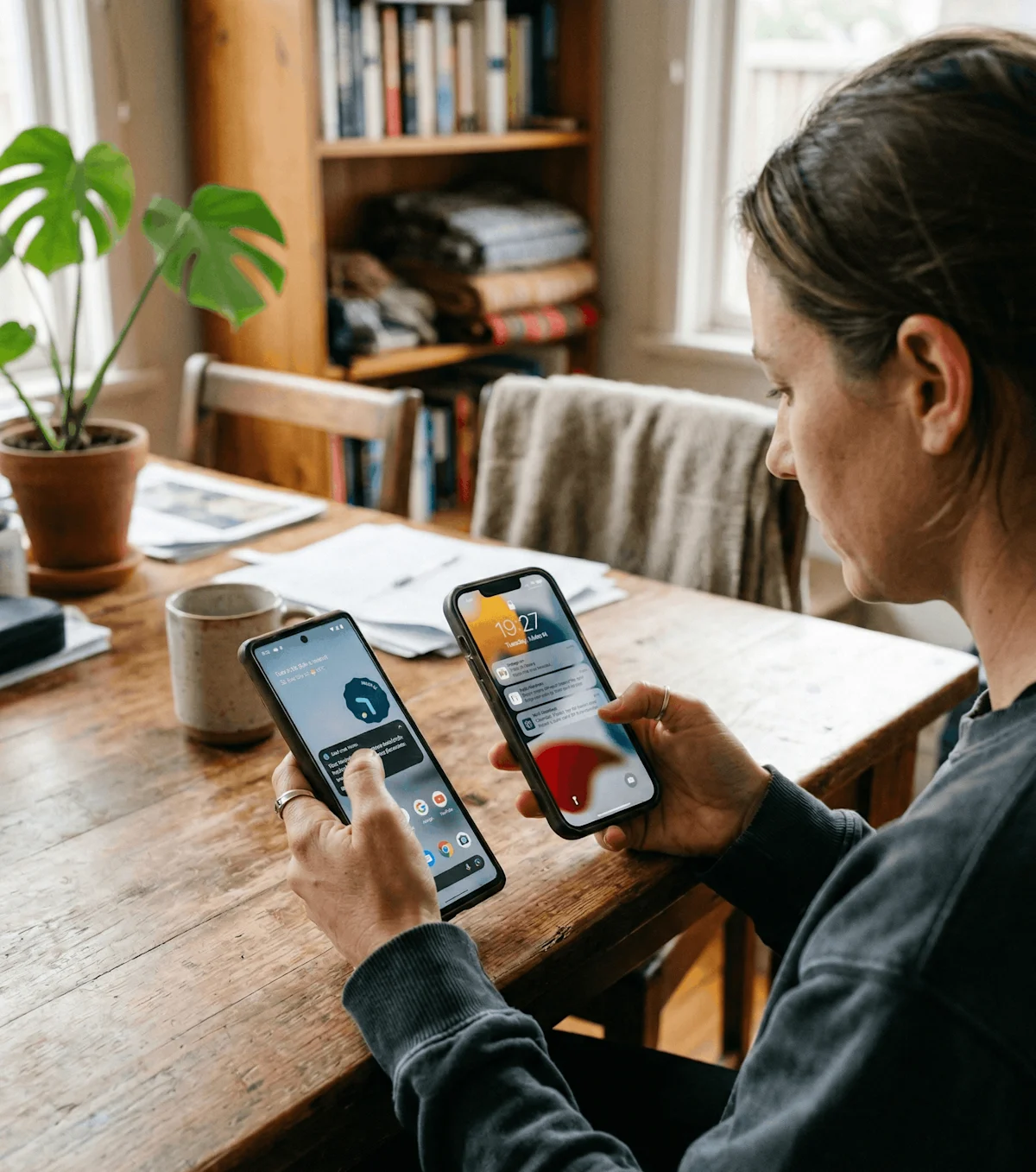
Single-platform iOS and Android costs are close. iOS native builds sit between $25,000 and $120,000; Android native between $25,000 and $100,000. Android requires more device testing, adding roughly 15% to QA costs, so for most briefs, the platform decision is driven by audience rather than budget.
App development cost by platform (2026, AUD exc. GST):
Platform | Cost range | Notes |
iOS only (native Swift) | $25,000–$120,000 | Fewer device variants; higher user spend per download |
Android only (native Kotlin) | $25,000–$100,000 | More device testing; ~15% higher QA cost |
Cross-platform (Flutter / React Native) | $50,000–$180,000 | Single codebase; saves ~30% vs native both |
Native both platforms | $100,000–$300,000+ | Separate codebases; double the testing |
For most Australian startups and SMEs in 2026, cross-platform development using Flutter or React Native is the practical default. A single codebase runs on both iOS and Android, saving roughly 30% compared with building natively for both. Performance is strong enough for the majority of commercial use cases.
How much does a Flutter app cost in Australia?
A Flutter app costs $50,000 to $180,000 for most standard commercial builds. Flutter produces cross-platform apps from a single codebase, representing one development effort rather than two. The cost saving over a native iOS-plus-Android build is $30,000 to $80,000 for equivalent functionality.
Should I build for iOS or Android first?
For budget-constrained startups, the practical recommendation is to launch on iOS first. iPhone users in Australia have higher average app engagement and in-app spending than Android users. Building for one platform first halves your testing scope and generates real user feedback before you commit to the second.
How are Android apps developed?
Android apps are built primarily using Kotlin (Google's preferred language since 2017) or Java. Cross-platform frameworks like Flutter and React Native also produce Android-compatible apps from a shared codebase. Development follows the standard seven stages: scoping, design, frontend, backend, testing, submission and maintenance.
Compare app developers on Bark
What does an app developer charge per hour in Australia?

Australian app developers charge $50 to $250 per hour in 2026, depending on experience and whether you're engaging a freelancer or an agency. The hourly rate alone is less useful than understanding what it covers. Agency rates absorb project management, QA and handover; freelancer rates often don't.
App developer hourly rates in Australia (2026, AUD exc. GST):
Provider type | Hourly rate | Notes |
Junior freelancer (1–3 yrs) | $50–$80 | Front-end, basic builds |
Mid-level freelancer (3–7 yrs) | $80–$120 | Full-stack, standard integrations |
Senior freelancer (7+ yrs) | $120–$200 | Lead dev, complex architecture |
Boutique agency | $100–$150 | PM, QA and dev included |
Mid-tier agency | $150–$200 | Full end-to-end delivery |
Top-tier / enterprise agency | $180–$250 | Regulated industries, complex briefs |
Freelancers cost 10 to 20% less than agencies at equivalent experience levels. The trade-off is project management. A senior freelancer suits a well-scoped brief; an agency absorbs the coordination overhead that most first-time builders underestimate.
App developer rates by city (2026, AUD inc. GST):
City | Hourly rate range |
Sydney | $120–$250 |
Melbourne | $100–$220 |
Brisbane | $100–$170 |
Perth | $100–$160 |
Adelaide | $90–$160 |
How do Australian developers compare to offshore developers?
Offshore developers in India and Southeast Asia charge $20 to $50 per hour. That's a real saving on paper. Time zone differences, communication overhead and revision cycles often reduce that saving for projects requiring close collaboration.
A hybrid model is most common for budget-conscious Australian businesses. An Australian project manager handles scoping, architecture and quality control, with offshore developers executing the build. This model requires an experienced local lead to work well.
Can I build an app without coding?

Yes. No-code platforms let you build functional apps without writing traditional code. They work well for simple, clearly defined use cases and cost considerably less than a custom build.
No-code app development platforms (2026):
Platform | Monthly subscription (approx. AUD) | Build cost with developer | Best for |
Bubble | $40–$160+/month | $5,000–$50,000 | Web apps, MVPs, SaaS |
Adalo | $50–$200+/month | $3,000–$30,000 | Mobile apps, simple UX |
FlutterFlow | ~$70/month | $5,000–$50,000 | Cross-platform mobile apps |
Subscription costs are approximate AUD equivalents. Platform pricing is published in USD (approx. 1 USD = 1.57 AUD, early 2026).
No-code platforms become a liability when a product outgrows them. Custom backend logic, complex integrations and large user loads are the most common ceiling-breakers. Needing to rebuild from scratch after hitting platform limits is expensive and more common than the platform marketing suggests.
Can ChatGPT build an app?
AI tools like ChatGPT can generate code, suggest architecture and speed up specific development tasks. They don't replace a developer for a production app. Human oversight is required for security, logic, testing and deployment.
The practical effect on cost is modest. A developer using AI tooling may complete certain phases faster, reducing billable hours on some tasks. Most reputable Australian developers now use AI assistance, but it doesn't change the fundamental cost structure of a complex build.
Is making an app easy?
Prototyping and design are accessible with modern tools. Backend development, security, device testing and app store submission are not. Most first-time builders underestimate the non-coding workload: testing and QA alone account for 10 to 15% of total build cost.
Can I create my own app for free?
Free tiers exist on Adalo, Bubble and FlutterFlow with significant limitations. Prototyping and internal testing are achievable without paying. Publishing to the App Store costs approximately $149 AUD per year; Google Play requires a one-time registration of approximately $38 AUD.
How can I develop my own Android app?
The most accessible route without a development background is a no-code platform like FlutterFlow or Adalo, both of which produce Android-compatible apps. Learning Kotlin or React Native is the path to building without a platform dependency. For a production-ready Android app, engaging a developer or agency is the reliable option for most business owners.
What are the 7 stages of app development?
Every production app follows the same seven stages, regardless of complexity or budget. Understanding this process lets you evaluate a proposal accurately and identify where cost overruns most often occur. Some frameworks describe five steps by merging certain phases; the model below reflects how most Australian agencies structure delivery.
1. Discovery and scoping

Discovery defines what the app does, who it's for and what it needs to integrate with. A thorough discovery phase produces a technical specification, user stories and a project timeline. Skipping or rushing this phase is the most common cause of budget overruns.
2. UI/UX design and prototyping
Design translates the specification into screen layouts and user flows. A clickable prototype is built before any code is written. UI/UX design accounts for 10 to 15% of total project cost.
UI/UX design costs for app projects (2026, AUD exc. GST):
Scope | Cost range |
Basic wireframes / prototype | $2,500–$5,000 |
Standard UI/UX (SME app) | $5,000–$15,000 |
Custom animations, premium UX | $15,000–$30,000 |
Enterprise-grade, high-fidelity | $20,000–$100,000+ |
For UI/UX design on app projects, design professionals on Bark cover prototyping, UX design and visual interface work.
3. Frontend development

Frontend development builds what users see and interact with. It accounts for roughly 20 to 25% of total project cost. This phase covers screen layouts, user interactions, animations and the connection between the interface and the backend.
4. Backend development
The backend handles data storage, business logic, user authentication, server infrastructure and third-party integrations. It's the largest single cost component, at 40 to 50% of a standard build. A weak backend is the most common source of performance and security problems after launch.
5. Testing and QA
Testing covers functional testing, performance testing, device compatibility and user acceptance testing. Budget 10 to 15% of the total build cost for QA on a standard app. Healthcare and fintech apps allocate 15 to 20%.
Testing and QA costs (2026, AUD exc. GST):
QA scope | Cost range |
Basic functional testing | $3,000–$15,000 |
Full QA (functional, load, UAT, device testing) | $8,000–$100,000+ |
6. App store submission and launch

Apple App Store submission requires an annual Apple Developer Program membership at approximately $149 AUD per year. Google Play requires a one-time registration of approximately $38 AUD. Submission preparation, review and store listing setup adds $2,000 to $5,000 to the project cost in most agency proposals.
App store listing assets, including icons, screenshots and promotional banners, are excluded from the developer's brief in most proposals. Graphic designers on Bark cover app icons, store screenshots and promotional assets for both platforms.
7. Post-launch maintenance and iteration
Maintenance is the most consistently underestimated item in any app budget. Budget 15 to 25% of the original build cost per year for ongoing maintenance. A $100,000 app costs $15,000 to $25,000 per year to keep running well.
Annual maintenance costs (AUD):
Category | Annual cost range |
Bug fixes and minor updates | $1,000–$5,000 |
Security patches | $1,000–$2,500 |
iOS / Android OS compatibility updates | $5,000–$30,000 |
Cloud hosting (small app) | $600–$6,000 |
Third-party API maintenance | $3,000–$20,000 |
Dedicated support retainer | $1,500–$10,000/month |
Post-launch visibility is a separate cost from maintenance. App Store Optimisation (ASO) covers keyword research, store listing copy and rating management to improve organic discovery. SEO specialists on Bark with digital product experience cover ASO as part of a broader launch strategy.
What drives the cost of app development?
Six factors create the largest pricing differences between proposals. Knowing each before reviewing quotes means you can assess them on their merits rather than comparing totals in isolation.
Third-party integrations

Each integration adds development time and ongoing running costs. Payment gateways, maps, push notifications, social login and in-app messaging are the most common.
Integration development costs (2026, AUD exc. GST):
Integration | Cost range |
User login and authentication | $2,000–$8,000 |
Push notifications | $1,500–$5,000 |
Payment gateway (Stripe, PayPal, Afterpay) | $3,000–$12,000 |
Maps and GPS tracking | $4,000–$18,000 |
In-app messaging / chat | $6,000–$25,000 |
Admin panel / dashboard | $5,000–$20,000 |
Social login (Facebook, Google) | $2,000–$8,000 |
AI-powered features | $15,000–$80,000+ |
API usage fees accumulate after launch. Stripe charges 1.7% plus $0.30 per domestic transaction; Google Maps API charges approximately $7 per 1,000 requests. Neither figure appears in most development proposals as these are operating costs, not build costs.
Compliance requirements
Healthcare and fintech apps carry regulatory obligations that standard commercial apps don't. The Privacy Act 1988 (Cth) governs how apps collect, store and handle personal data. Non-compliance carries significant penalties enforced by the Office of the Australian Information Commissioner.
PCI-DSS and APRA requirements add further cost to fintech builds in both the development and testing phases. These compliance layers are why healthcare apps start at $120,000 and fintech at $150,000. Budget a compliance audit as a separate line item before development begins.
Platform choice
Cross-platform development costs roughly 30% less than building natively for both iOS and Android. That saving is real but comes with a trade-off: native apps deliver better performance for graphics-intensive or hardware-dependent use cases. For most business apps, the performance gap doesn't justify the cost premium.
Team structure
A solo developer costs less per hour but delivers more slowly and without dedicated QA or project management. A five-person agency team (project manager, designer, frontend, backend, QA) delivers faster and with fewer revision cycles. The total cost difference between a well-managed freelancer and a mid-tier agency is smaller than the hourly rate gap suggests.
Post-production depth
Testing, QA and submission preparation are the phases most often quoted at a minimum and invoiced at a maximum. A basic functional test and a full device-and-load QA suite both fall under "testing" in a proposal. Always ask what's included in the QA line item specifically.
Contingency budget
Every app project should carry a contingency reserve of 10 to 15% on top of the quoted build cost. Unexpected integration failures, scope adjustments and third-party API changes all generate unplanned variation fees. A $150,000 build should have $15,000 to $22,500 set aside before work begins.
Common budgeting mistakes in Australian app projects

App projects that run over budget almost always do so for the same reasons. These four mistakes account for the majority of cost blowouts in Australian development projects.
1. Omitting the admin panel from the brief
The mobile app is not the whole product. Most apps require a separate web-based admin panel for managing users, orders or content, at an additional $5,000 to $20,000. Raising this requirement after development starts costs considerably more than scoping it from day one.
2. Treating maintenance as optional
An app without a maintenance budget is on a countdown. Every major iOS and Android release introduces changes that break existing functionality. Apps that go unmaintained lose users faster than any competitor can take them.
3. Accepting a quote without a fixed scope
A time-and-materials contract places all budget risk with the client. Features added mid-build cost two to three times more than they would have during the scoping phase. Always confirm whether a quote is fixed-price or time-and-materials before signing.
4. Confusing no-code speed with no-code scalability
No-code platforms produce working apps quickly at low initial cost. They hit hard limits under load, with complex integrations or when user numbers grow. Rebuilding from a no-code foundation to a custom codebase costs more than starting custom from the beginning.
What is an MVP and how much does it cost to build in Australia?

An MVP (minimum viable product) is the smallest version of an app that delivers its core value to real users. It's built to test whether the product works in the market before committing to a full build. Most serious digital products start as MVPs.
MVP development costs in Australia (2026, AUD exc. GST):
Approach | Cost range | Notes |
Clickable prototype only (no backend) | $5,000–$15,000 | Design and UX only; no functional code |
Offshore-built MVP | $25,000–$70,000 | Core features only; quality varies |
Australian-built MVP | $70,000–$200,000 | Wave Digital reports most MVPs at $125K–$250K |
A well-scoped MVP ships three to five core features and deliberately excludes everything else. Every feature added to an MVP increases cost and delays the market feedback that the MVP is designed to generate. The scope decision matters more than the budget decision.
What are the app development maturity stages?
Most production apps pass through four maturity stages before reaching full scale. Understanding each stage helps set a realistic budget for the full product journey, not just the first build.
Stage | Description | Indicative cost (AUD exc. GST) |
Proof of concept (PoC) | Technical feasibility test; no user interface | $5,000–$15,000 |
Prototype | Clickable design model; no backend code | $5,000–$15,000 |
MVP | Functional core product shipped to real users | $70,000–$200,000 (AU agency) |
V1 and beyond | Feature expansion based on real user data | 20–30% of original build per cycle |
Each stage informs the next. A product that skips straight to a full V1 without a validated MVP carries substantially higher commercial risk.
What should I budget for app updates after launch?
The first build is rarely the final product. Most apps go through two to three significant feature iterations in the first 18 months based on real user behaviour. Budget 20 to 30% of the original build cost per major iteration cycle, on top of the base maintenance reserve.
What app development trends are affecting costs in 2026?

Three developments are changing what Australian businesses should expect to pay and what they can reasonably request in a 2026 brief.
AI-powered features
AI-powered features are now a standard request in commercial app briefs. Integrating large language models, recommendation engines or automated moderation adds $15,000 to $80,000 to a build. Developers with proven AI integration experience command a 15 to 25% rate premium over generalist app developers.
5G and real-time features
5G adoption across Australian cities is making real-time features more viable for standard commercial briefs. Live video, AR overlays and high-frequency GPS tracking no longer require a native-only approach. Each adds meaningful development and infrastructure cost to the overall project budget.
Cross-platform framework maturity
Flutter's share of Australian commercial projects continues to grow in 2026, reducing the cost premium for cross-platform builds. React Native remains strong for teams with existing JavaScript experience. Both frameworks now support most features previously restricted to native development, narrowing the performance gap further.
Super app architecture
Super app architecture is gaining traction in Australia, drawing on the success of WeChat-style platforms in Southeast Asia. A super app combines payments, messaging, bookings and loyalty within one interface. Building at this scale starts at $500,000 and requires a dedicated product team.
Is app development tax-deductible in Australia?

App development commissioned for business purposes is deductible or depreciable, depending on how the expense is classified. The treatment differs based on whether the app is a new capital asset or an ongoing operational cost.
A new custom-built app is treated as a capital asset and depreciated over its effective life. The Australian Taxation Office sets the effective life for software at 2.5 years, equating to a 40% diminishing value rate or 25% straight-line. Businesses with aggregated annual turnover below $10 million can use simplified depreciation rules, including the instant asset write-off for assets below the current ATO threshold.
For innovative development involving genuine technical uncertainty, the Australian R&D Tax Incentive offers a 43.5% refundable offset for companies with aggregated turnover below $20 million. This can result in a cash refund even if the business is in a tax loss position. Routine development doesn't qualify; the incentive applies to projects resolving real technical uncertainty.
GST at 10% applies to development services provided by an Australian developer. Offshore development services may be subject to the reverse charge mechanism, requiring the Australian business to self-assess GST. A registered tax agent can advise on the correct treatment for your specific project.
What to ask a developer before you send the brief

A well-scoped brief produces a more accurate proposal. These questions surface the cost items most commonly omitted from first-draft quotes.
Scoping and approach
Have you built apps in this category before, and can I see recent examples at this scale? How do you handle discovery and scoping: is it included in the project fee or billed separately? Do you manage design, backend and QA in-house or do you subcontract any phases?
Rate structure and inclusions
Is your quote fixed-price or time-and-materials, and what triggers a variation? Does the quote include UI/UX design, the admin panel, testing and app store submission? What is your hourly rate for work outside the agreed scope?
Platform and tech stack
What platform and framework do you recommend for this brief, and why? Do you build natively or cross-platform, and what are the long-term maintenance implications of that choice? Who owns the codebase and all associated IP at handover?
Post-launch and maintenance
What does post-launch support include and for how long after delivery? What is your annual maintenance retainer, and what does it cover? How do you handle iOS and Android OS updates that break existing functionality?
Get competing quotes before you commit
App development in Australia costs $20,000 to $700,000+, with most standard commercial builds landing between $50,000 and $200,000 (exc. GST). Developers charge $50 to $250 per hour, depending on experience and team structure. Maintenance runs 15 to 25% of the original build cost per year.
The most expensive mistake in any app project isn't choosing the wrong platform. It's accepting a proposal before you've compared two or three and confirmed exactly what every line item covers. Bark's network of Australian app developers has been rated 4.79 stars across 10,003 reviews from more than 10,250 project requests.
FAQs
Only if they’re authorised to perform the work where the property is located. Licensing and mutual-recognition rules differ between jurisdictions.
Confirm their authority before sending the contract or paying a fee.

Other guides you might be interested in


Explore all guides about growing your business
Scale your business with the right experts. Explore step-by-step guides on hiring web designers, planning work events, office cleaning, and legal services with Bark.