How much does marriage and relationship counselling cost?
Last updated March 27, 2026
Compare the costs of relationship and marriage counselling in Australia in 2026. See private session rates, free government-funded options and the key factors that influence what you’ll pay.

How much does marriage and relationship counselling cost?
Last updated March 27, 2026
Compare the costs of relationship and marriage counselling in Australia in 2026. See private session rates, free government-funded options and the key factors that influence what you’ll pay.
Written by

Relationship counselling in Australia costs $130 to $250 per session, GST-free, at most private practices in 2026. The national average sits at $170 for a standard 60-minute session with an accredited counsellor. Bark's analysis of 17,900+ requests matched with 1,460+ counsellors across Australia shows most couples budget $1,020 to $1,700 for 6 to 10 sessions.
Get free quotes from relationship counsellors near you
That headline rate doesn't tell the whole story. A subsidised session at $90 with a 6-week wait is less practical than a $170 private session available this week.
An EFT specialist charging $250 who resolves core issues in 5 sessions costs $1,250 total. A generalist at $150 who needs 12 sessions costs $1,800.
Here's what relationship counsellors charge across every Australian state and how marriage counselling costs add up over a full course of treatment. You'll also find where to access free or subsidised couples counselling if private rates aren't an option right now.
What does a relationship and marriage counsellor do?

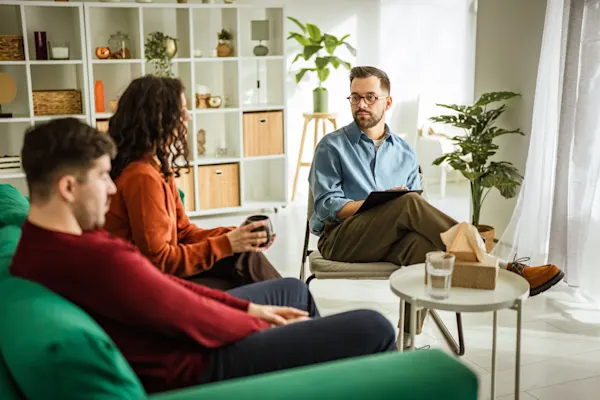
A relationship or marriage counsellor works specifically with couples rather than individuals. Their job is to hold the dynamic between two people: to hear both perspectives, spot unhealthy patterns, and build better ways of communicating.
The issues couples bring to sessions span a wide range. Communication breakdown is the most common presenting reason, followed by conflict escalation, intimacy concerns and trust issues from infidelity or dishonesty. Others come with more specific goals: managing a major life transition, navigating parenting disagreements or preparing for a significant commitment like marriage.
Sessions usually run 50 to 60 minutes. Many practices schedule an extended first appointment of 80 to 90 minutes to allow both partners to share their history before active work begins.
What happens in a couples counselling session?
The first session is an assessment. The counsellor gathers background on the relationship and what each partner wants to achieve. Most experienced counsellors will also meet briefly with each partner individually at some point early in the process, giving each person space to speak openly.
From the second or third session, the work becomes more active. The counsellor introduces exercises, communication frameworks and reflective techniques drawn from their therapeutic approach. Both partners usually receive practices to try between sessions: structured conversations, journalling prompts or behavioural experiments designed to break specific conflict cycles.
Progress isn't linear. Most couples find sessions 3 to 5 harder than session 1, because the work is reaching real patterns rather than surface complaints. Genuine shifts typically start to show from sessions 6 to 8.
How is a relationship counsellor different from a couples therapist?
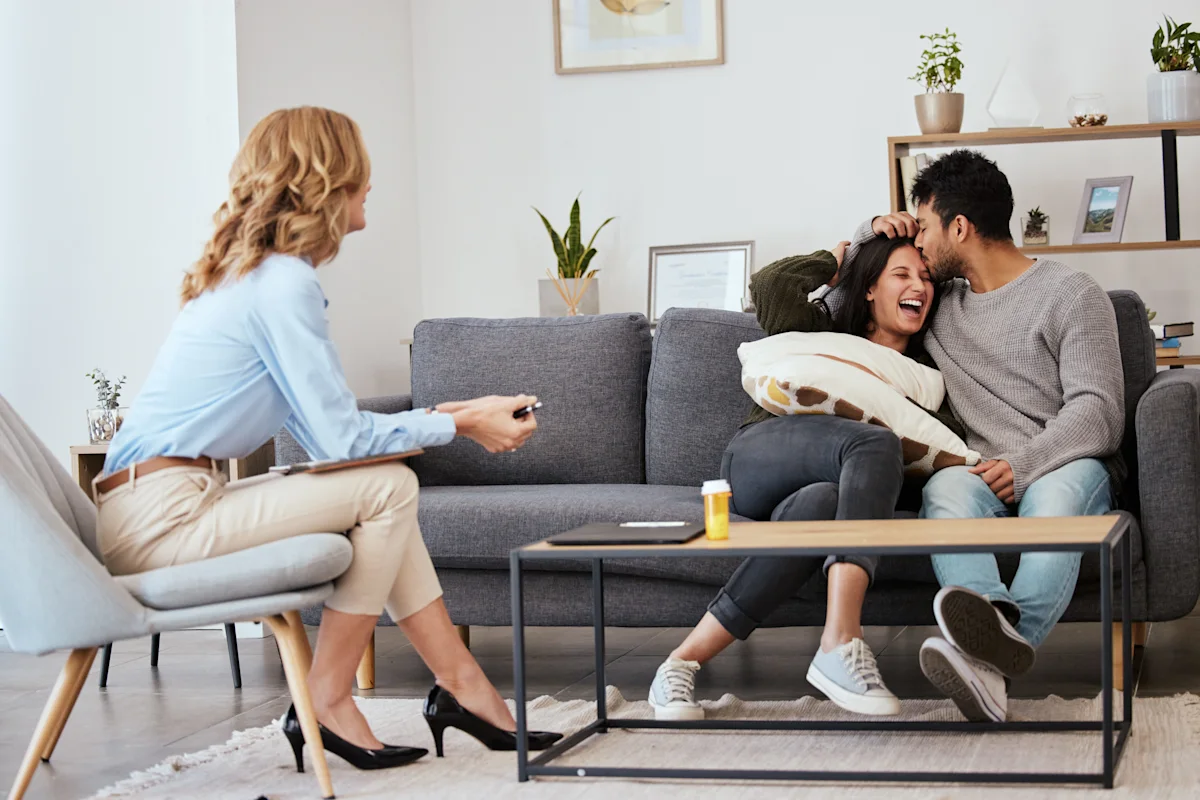
There's no legal distinction between these titles in Australia. "Counsellor" and "therapist" are unprotected terms anyone can use regardless of formal training. "Psychologist" is a protected title regulated by the Australian Health Practitioner Regulation Agency (AHPRA).
Counsellors working with couples come from several training backgrounds. Social workers, ACA-registered counsellors, PACFA-registered counsellors, registered psychologists and clinical psychologists all work in this space. Their training depth, regulatory oversight and fees differ considerably.
The most important question isn't which title a practitioner uses. It's whether they have specific post-graduate training in couples therapy. And whether they're registered with a professional body that enforces ethical and competency standards.
What therapeutic approaches do relationship counsellors use?
Emotionally Focused Therapy (EFT) was developed by Canadian psychologist Sue Johnson and is built on attachment theory. It identifies and shifts the negative interaction cycles that keep couples stuck in recurring conflict.
EFT is the most researched couples approach globally, with 70% to 73% of couples recovering from distress and 90% reporting significant improvement. EFT-trained counsellors in Australia typically charge $180 to $280 per session, GST-free.
The Gottman Method draws on decades of observational research by Dr John and Dr Julie Gottman. It focuses on building friendship, managing conflict constructively and creating shared meaning within the relationship.
Gottman-certified therapists are rarer in Australia and tend to charge $200 to $320 per session, GST-free. Some also offer the Gottman Couples Checkup as a standalone assessment for $150 to $250, GST-free.
Cognitive Behavioural Therapy (CBT) for couples focuses on identifying thought patterns that drive destructive behaviour between partners. It's widely used by psychologists and is well-suited to relationships where one or both partners has an anxiety or mood disorder directly affecting the dynamic.
Imago Relationship Therapy is a structured dialogue-based approach that helps partners understand how early childhood attachment experiences shape adult relationship patterns. It's often used for couples dealing with recurring conflict that seems disproportionate to the surface issue.
Narrative Therapy helps couples reframe the story they tell about their relationship, moving away from problem-saturated narratives toward a shared understanding. It's frequently used in culturally sensitive practice and with couples navigating major identity transitions.
If issues have escalated to co-parenting conflict or family breakdown, family counselling may address a broader set of dynamics than couples counselling alone.
How much does couples counselling cost in Australia?

All relationship and marriage counselling in Australia is GST-free under ATO health service guidelines. This applies across all practitioner types listed below. Confirm with your specific practice at booking, as it applies in almost all cases but can vary where a practice invoices separately for administrative components.
Relationship counselling costs vary most by the counsellor's qualification level, professional registration and years of experience. The table below shows what you'll realistically pay at each level in 2026.
Relationship counselling cost by qualification and experience:
Qualification level | Lowest rate | Average rate | Highest rate | Session length |
Graduate counsellor (0-2 years) | $80 | $105 | $130 | 50-60 min |
Accredited counsellor (ACA/PACFA, 2-5 years) | $130 | $160 | $190 | 50-60 min |
Senior counsellor (5-10 years) | $160 | $185 | $230 | 50-60 min |
Principal counsellor (10+ years) | $180 | $220 | $280 | 60-90 min |
Registered psychologist | $170 | $230 | $310 | 50-60 min |
Clinical psychologist | $200 | $280 | $435 | 60-90 min |
Graduate counsellors: $80 to $130 per session
Graduate counsellors have completed a Bachelor's or Graduate Diploma in counselling or social work and are in the early stage of professional practice. They're fully qualified but carry limited clinical experience. That matters most for complex presentations: affair recovery, serious trauma or deeply entrenched conflict cycles.
For couples dealing with early-stage communication issues or adjusting to a major life change, a graduate counsellor is often genuinely effective. Many practise under formal supervision, meaning a senior clinician reviews their work. That's a quality safeguard most couples don't realise exists at this relationship counselling cost level.
Accredited counsellors: $130 to $190 per session
This tier covers counsellors registered with ACA or PACFA with 2 to 5 years of supervised practice. ACA accreditation requires at least 750 hours of supervised client contact and ongoing professional development. PACFA has comparable requirements under its Registered Counsellor category.
The practical significance of registration is accountability: if ethical standards are breached or something goes wrong, you have a formal complaints pathway. Unregistered practitioners don't provide this protection regardless of years in practice. For a process as sensitive as couples counselling, verifying registration before paying anything matters.
At $130 to $190 per session, GST-free, this tier represents the best value for most couples with moderate relationship difficulties. The combination of formal training, supervised experience and institutional accountability is solid at this price point.
Senior and principal counsellors: $160 to $280 per session
Senior counsellors with 5 to 10 years of experience and principal counsellors with 10 or more years charge proportionally more. The premium reflects accumulated clinical hours and the pattern recognition built from working with hundreds of couples. That depth shows most clearly in sessions 2 and 3.
A senior counsellor typically identifies core attachment patterns and starts active intervention faster than a less experienced practitioner. Fewer sessions follow as a result. Six sessions at $220 each ($1,320, GST-free) compares well against 15 sessions at $150 each ($2,250, GST-free).
Registered psychologists: $170 to $310 per session
A registered psychologist holds an accredited postgraduate degree in psychology and is regulated by AHPRA under national law. They address both the individual psychology of each partner and the relational dynamic between them. This dual lens is most valuable when relationship distress is directly tied to individual mental health presentations.
Individual sessions with a registered psychologist can attract Medicare rebates under a Mental Health Care Plan (MHCP). Joint couples sessions do not qualify for rebates. This is covered in detail in the Medicare section below.
Find registered psychologists who work with couples on Bark
Clinical psychologists: $200 to $435 per session
Clinical psychologists have completed Master's or Doctoral-level training focused on assessing and treating mental health conditions. They're best suited to relationships complicated by PTSD, complex trauma, severe anxiety or mood disorders directly affecting the relationship.
Most clinical psychologists offering couples work charge $210 to $280 per session, GST-free. The upper range ($350 to $435) reflects senior practitioners in high-demand city practices. Extended 90-minute sessions are typically charged pro-rata.
Individual clinical psychology sessions under an MHCP attract a Medicare rebate of $137.05 per session (2025-26 rate) for up to 10 sessions per calendar year. This doesn't apply to joint sessions, but a hybrid structure of individual and joint sessions can partially offset total relationship counselling costs.
How much does couples counselling cost by state and city?

Location affects couples counselling costs significantly. Practitioners in inner-city areas carry higher room hire, administrative staffing and insurance costs. Those flow directly into session rates.
The same counsellor moving from a suburban to a CBD practice would typically raise their rate by 15% to 25% to cover the overhead difference. A counsellor 25 minutes from the CBD will often charge meaningfully less for equivalent experience and qualifications. Telehealth removes geography as a cost factor entirely.
Couples counselling cost by city:
City | Average per session | Lower end | Upper end | Notes |
Sydney | $200 | $140 | $310 | CBD practices highest; inner west and north shore slightly lower |
Melbourne | $190 | $135 | $295 | Outer suburbs typically 15-20% less than inner city |
Canberra | $190 | $140 | $290 | Higher demand and lower practitioner density than other capitals |
Brisbane | $175 | $120 | $265 | South-east Queensland mid-range supply is growing |
Perth | $170 | $115 | $260 | Metro rates similar to Brisbane; regional WA lower |
Adelaide | $160 | $105 | $240 | Most affordable capital city market nationally |
Hobart | $155 | $105 | $230 | Limited supply but mid-range well covered |
Darwin | Income-tested | $50 | $170 | Relationships Australia NT is the dominant provider |
All prices are GST-free, based on private practice rates per 60-minute session. Regional pricing is typically 10% to 20% below the nearest capital city.
Online and telehealth relationship counselling costs
Online relationship counselling sits between $110 and $210, GST-free, regardless of where in Australia the counsellor is based. That's typically $30 to $60 less per session than the same practice's in-person rate. A counsellor based in Melbourne can work with a couple in regional Queensland at telehealth rates, removing geography as a barrier to experienced specialists.
Relationship counselling cost by session format
Format | Typical rate | Best suited to |
In-person, metro CBD | $165 to $310 | Couples prioritising face-to-face work |
In-person, suburban | $120 to $230 | Most accessible format for metro couples |
Telehealth, video | $110 to $210 | Regional couples; split or busy schedules |
Telehealth, phone | $90 to $175 | Limited internet access; video anxiety |
Intensive retreat | $800 to $2,500 | Couples wanting concentrated progress |
All prices are GST-free.
Telehealth outcomes for relationship counselling are comparable to in-person work for most presentations. The main limitation is non-verbal communication. For couples where physical safety or acute distress is a concern, in-person sessions are strongly preferred.
The intensive retreat format suits couples with irregular schedules or those wanting concentrated progress. Full-day couples intensives cost $800 to $1,500, GST-free, and cover the equivalent of 8 to 12 standard sessions. Weekend retreats run $1,500 to $2,500, GST-free.
Comparing relationship counselling costs across Australia? Post your job on Bark and get quotes from qualified counsellors near you at no cost.
How many sessions does relationship counselling take, and what does it cost in total?

Session count drives total relationship counselling cost more than the per-session rate. A counsellor at $200 per session across 5 visits costs $1,000, GST-free.
The same counsellor across 14 visits costs $2,800, GST-free. Getting a realistic session estimate in your first consultation is one of the most financially useful conversations you can have.
Most counsellors give a range rather than a fixed number, because genuine need varies by couple. They should still offer a realistic estimate based on what you've described. If your counsellor can't give any guidance after hearing your situation in session 1, that's worth asking about directly.
Typical session counts by issue type
Issue type | Typical sessions | Key variable |
Communication issues, early-stage strain | 4-6 | Motivation of both partners |
Major life transition (new baby, job loss, relocation) | 5-8 | Severity of resulting conflict |
Trust breach or infidelity | 8-15 | Whether full disclosure has occurred |
Recurring conflict, long-standing patterns | 8-12 | How long patterns have been entrenched |
Pre-marital or pre-commitment counselling | 4-8 | Whether structured tools like PREPARE/ENRICH are used |
Separation or decision counselling | 4-8 | Clarity of each partner's position |
Post-affair recovery | 12-20 | Degree of trauma in the betrayed partner |
Co-parenting conflict | 6-10 | Entrenched conflict level and children's needs |
Total relationship counselling cost by session count
Sessions | At $130/session | At $170/session | At $220/session | At $280/session |
4 sessions | $520 | $680 | $880 | $1,120 |
6 sessions | $780 | $1,020 | $1,320 | $1,680 |
8 sessions | $1,040 | $1,360 | $1,760 | $2,240 |
10 sessions | $1,300 | $1,700 | $2,200 | $2,800 |
12 sessions | $1,560 | $2,040 | $2,640 | $3,360 |
15 sessions | $1,950 | $2,550 | $3,300 | $4,200 |
All prices are GST-free. Session count depends on issue complexity and how both partners engage with the process.
Is 20 sessions of couples therapy a lot?
Twenty sessions is at the upper end of what most couples need, but it's not unusual for specific presentations. Post-affair recovery and deeply entrenched long-term conflict both sit in the 12 to 20 session range in clinical practice.
Twenty sessions usually signals complexity. The couple may have sought help late after years of unaddressed conflict, or progress may have been interrupted by external stressors. It's not itself a sign the therapy isn't working.
If you're at session 8 or 10 with no clear progress, raise it directly with your counsellor. A good practitioner will either identify what's blocking progress or refer you to someone better suited to your situation.
Block booking discounts
Some Australian relationship counsellors offer 5% to 10% off when couples prepay a block of 6 or 8 sessions. Ask about this in your first or second session, not after you've already committed to booking one at a time.
Prepaid blocks are usually non-refundable beyond what's already been used. Confirm the refund policy in writing before paying upfront.
Maintenance sessions after active treatment ends
Many couples return for 1 to 3 maintenance sessions 3 to 6 months after their main course of treatment ends. These aren't a sign the relationship counselling didn't work. They're a practical reinforcement of skills built during active treatment, usually prompted by a new stressor or life event.
Budget $170 to $510, GST-free, for maintenance sessions when calculating multi-year couples counselling costs.
What factors affect relationship counselling costs?

Seven factors create real pricing differences between counsellors who appear to charge similar rates on paper.
Professional registration and accreditation
"Counsellor" and "therapist" are unprotected titles in Australia. Anyone can use them. Verifying registration before booking is the single most important step when comparing relationship counselling costs.
For psychologists, check the AHPRA national register directly to confirm current registration. For counsellors, check ACA or PACFA membership on their respective websites. Both enforce ethical codes with formal complaints processes.
An unregistered practitioner charging $110 per session has no external accountability. That's a risk that lower relationship counselling cost doesn't justify.
Specialist training in couples therapy
Post-graduate training in EFT, the Gottman Method or Imago Therapy involves significant additional investment by the practitioner. That flows through to session rates: EFT-trained counsellors typically charge $180 to $280 per session, GST-free, and Gottman-certified therapists charge $200 to $320.
Whether that premium delivers better value depends on your situation. For deeply entrenched patterns, a specialist approach typically reaches resolution in fewer sessions. Six sessions at $220 each ($1,320 total, GST-free) compares well against 15 sessions at $150 each ($2,250 total, GST-free).
Session length and format
Standard sessions run 50 to 60 minutes. Initial couples assessments often run 80 to 90 minutes to cover both partners' histories. Extended sessions are typically charged pro-rata.
A practice charging $170 for 60 minutes will usually charge $245 to $260 for a 90-minute first session, GST-free. Some practices charge a flat rate regardless of how long the first session runs. Clarify this before booking.
Location and practice overhead
CBD practices charge 15% to 25% more than suburban equivalents for the same qualifications and experience level. Telehealth removes the location premium entirely, typically saving $30 to $60 per session, GST-free, compared to in-person at the same practice.
Cancellation and rescheduling policies
Most Australian practices require 24 to 48 hours' notice to cancel or reschedule without charge. Missing that window typically costs 50% to 100% of the session fee; on a $170 session, that's $85 to $170, GST-free. Over a 10-session course, that's a 5% to 10% increase in total relationship counselling costs for a single missed window.
Initial intake and assessment fees
Some practices charge $50 to $150 separately for intake administration, initial questionnaires or assessment tools like the PREPARE/ENRICH inventory. Others absorb this into the first session fee.
A practice quoting $170 per session with a $120 intake fee has an effective first-session cost of $290, GST-free. Ask explicitly before your first booking.
Waiting time as a real cost
Waiting time doesn't appear on an invoice, but it affects your relationship while you wait. For couples in acute crisis, 6 to 8 weeks waiting for a subsidised session carries real cost. Factor urgency into your total couples counselling cost calculation.
Is couples therapy covered by Medicare?
Medicare does not provide rebates for relationship counselling or couples therapy sessions. This is the most common budgeting mistake couples make when researching marriage counselling costs.
A Mental Health Care Plan (MHCP) is accessed through a GP referral. It allows eligible individuals up to 10 individual psychology sessions per year under the Better Access Scheme. The key word is "individual": joint sessions don't qualify, regardless of the practitioner's qualifications.

When Medicare can still reduce your couples counselling costs
If one or both partners has a diagnosed mental health condition directly affecting the relationship, individual psychology sessions under an MHCP can be Medicare-rebated. Those sessions can address relationship patterns as they relate to the individual's mental health. This is clinically appropriate, not a workaround.
Running individual Medicare-rebated sessions alongside joint private-pay couples sessions is a legitimate hybrid structure. Some of the total relationship counselling cost is offset through rebates while joint work continues separately.
Medicare rebates for individual sessions (Better Access Scheme, 2025-26)
Practitioner type | Medicare rebate | Typical fee | Typical out-of-pocket |
Registered psychologist | $92.90 | $170 to $250 | $77 to $157 |
Clinical psychologist | $137.05 | $200 to $320 | $63 to $183 |
All fees are GST-free. Rebates apply to individual sessions only, not joint couples sessions.
To access this pathway, book an appointment with your GP. Describe both the mental health symptoms and how they're affecting the relationship. If the GP agrees a diagnosis is appropriate, they'll issue an MHCP.
Then find a registered or clinical psychologist who works with both individual and couples presentations. Ask whether a hybrid structure makes clinical and financial sense.
Can private health insurance reduce your relationship counselling costs?

Private health insurance with extras cover can offset some couples counselling costs. Coverage varies significantly between funds, policy tiers and the counsellor's registration type.
Funds that commonly include psychology or counselling rebates in extras cover include Bupa, Medibank Private, AHM, HCF, NIB and CBHS. Standard rebates run $20 to $80 per session, GST-free, depending on your extras tier, up to an annual cap of $300 to $800 per person.
Before your first appointment, ask your fund four specific questions:
- Does my extras cover include psychology or counselling rebates?
- Does the rebate apply to relationship counselling or couples sessions specifically?
- Does the practitioner need AHPRA, ACA or PACFA registration for me to claim?
- What's my remaining annual benefit for this calendar year?
Many funds pay rebates only for AHPRA-registered psychologists. Some extend rebates to ACA or PACFA-registered counsellors at a lower rate. Unregistered practitioners attract no rebate regardless of experience.
Annual limits reset on 1 January for most funds. If you're starting relationship counselling in the second half of the year, check what benefit you've already used.
Here's what that looks like in practice: a couple paying $170 per session across 8 sessions spends $1,360, GST-free, for the year. With each partner claiming $55 per session up to a $400 annual limit, they recover $440 between them. Net out-of-pocket cost: $920.
Can you get free couples counselling in Australia?

Yes. Several established providers offer genuine relationship counselling at significantly reduced or no cost. Counsellors at these services hold the same professional qualifications as private practitioners and are bound by the same accreditation standards.
Low-cost relationship counselling options in Australia:
Provider | Cost per session | Income tested | Waiting time | Availability |
Family Relationship Centres | Free (first 1.5 hrs); then subsidised | Yes, for ongoing | 1-4 weeks | 65+ centres nationally |
Relationships Australia | $0 to $180, sliding scale | Yes | 2-8 weeks | All states and territories |
Interrelate | From $50 concession; $90 standard | Partial | Varies | NSW, ACT, some QLD |
Centacare / CatholicCare | $0 to $100, income-tested | Yes | Varies by diocese | Major cities and regional areas |
Community health centres | $0 to $60 | Sometimes | 4-12 weeks | Location-dependent |
University training clinics | $0 to $50 | No | Varies by semester | Capital cities |
Employee Assistance Programme | Free (4-6 sessions) | No | 1-2 weeks | Through employer HR |
All subsidised prices are GST-free where applicable.
Family Relationship Centres
Family Relationship Centres are funded by the Australian federal government through the Department of Social Services. The first 1.5 hours of counselling or mediation are free for all couples, regardless of income. There are no means tests and no referral requirements for the initial appointment.
After the first free session, fees are subsidised on a sliding scale. Low-income couples pay $0 to $30 per session, GST-free. Mid-income couples typically pay $30 to $65, GST-free.
Higher-income couples pay up to $100, GST-free. There are over 65 centres operating nationally. Find your nearest at familyrelationships.gov.au.
Family Relationship Centres also offer parenting after separation programs and dispute resolution for co-parenting matters. For couples navigating separation with children, they're a strong first stop.
Relationships Australia
Relationships Australia is the largest non-profit relationship support provider in Australia, operating in every state and territory. Fees run on an income-tested sliding scale. Couples on lower incomes can access sessions for as little as $0 to $30, GST-free.
Those on higher incomes pay towards market-adjacent rates. Waiting times in metro Sydney and Melbourne typically run 4 to 8 weeks for non-crisis appointments. Some regional branches have shorter waits due to lower local demand.
Interrelate
Interrelate operates primarily in NSW and ACT, with some Queensland locations. Concession rates start at $50 per session, GST-free, for eligible couples. Standard rates sit around $90 per session, GST-free, substantially below comparable private practices in the same regions.
Interrelate counsellors are professionally accredited and work from an evidence-based framework. Programs cover relationship education, conflict resolution and post-separation parenting.
Centacare and CatholicCare
Centacare and CatholicCare operate across most Australian dioceses and offer relationship counselling on an income-tested basis. Services are open to all regardless of religious affiliation. Session costs typically range from $0 to $100, GST-free, depending on household income.
Many locations offer structured programs: PREPARE/ENRICH for engaged couples and PAIRS (Practical Application of Intimate Relationship Skills) for established couples dealing with recurring difficulties.
Employee Assistance Programmes
Many Australian employers fund 4 to 6 confidential counselling sessions per year through an Employee Assistance Programme (EAP). Relationship issues are covered by most EAP providers. Sessions are free at the point of use and confidential from your employer.
Check your HR policy before paying out of pocket. EAP access typically takes 1 to 2 weeks. Most sessions are structured for individual attendance.
Some providers accommodate joint couples sessions within the same allocation. Ask specifically when booking.
University training clinics
Several Australian universities with psychology or counselling programs offer sessions delivered by supervised trainee psychologists. Fees run $0 to $50 per session, GST-free, and clinical quality is monitored through formal supervision requirements. These clinics suit couples with straightforward communication or adjustment issues rather than complex trauma or crisis presentations.
Still weighing your options? Post your job for free on Bark and compare quotes from accredited relationship counsellors across Australia before committing to a single session.
Is relationship counselling worth it?

Research on couples therapy is among the clearest in psychological literature. EFT shows 70% to 73% of couples moving from clinical distress to non-distress, with 90% reporting significant improvement in relationship satisfaction.
The Gottman Method produces comparable findings in independent replications. Even generalist couples counselling without a structured approach shows improvement rates above 60%.
The financial comparison to separation is stark. Family lawyers in Australia charge $300 to $600 per hour.
An uncontested separation involving property settlement and parenting arrangements typically costs $5,000 to $15,000 in legal fees per party. Contested family law matters regularly exceed $50,000 per party before resolution.
Even 15 sessions of marriage counselling at $170 each, totalling $2,550, GST-free, is a fraction of the first month of contested separation legal fees. For couples with children, family mediation before legal proceedings are initiated can resolve parenting arrangements at substantially lower cost than court intervention.
What percentage of marriages survive counselling?
Research doesn't frame outcomes as survival rates, and that framing matters. Couples therapy success is measured by recovery from distress and improvement in relationship satisfaction, not simply whether a couple stays together.
EFT shows 70% to 73% of couples moving from clinically distressed to non-distressed after a full course of treatment. The Gottman Method produces comparable findings. Even less structured couples counselling shows meaningful improvement in over 60% of cases.
Staying together isn't always the right outcome. Some couples complete relationship counselling and decide to separate with clarity, mutual respect and a workable co-parenting arrangement. That's a successful therapeutic outcome, and far better than years of unaddressed conflict ending in a destructive separation.
Early intervention reduces total relationship counselling costs
Couples who seek help at the first signs of serious strain typically resolve core issues in 4 to 6 sessions. Those who wait until communication has collapsed or trust is severely damaged typically need 12 to 20 sessions. That's if they get there at all.
Research on delay is consistent. Every year a couple waits after problems become apparent increases average session count by 2 to 3 sessions.
A 3-year delay typically adds 6 to 9 sessions to a course of treatment. At $170 per session, that delay adds $1,020 to $1,530 to total relationship counselling costs, before counting the relational damage accumulated during the waiting period.
What drives good outcomes
Three factors consistently predict positive outcomes in couples therapy. Motivation of both partners is the strongest single predictor. Couples where both genuinely examine their own contributions to conflict show significantly better outcomes than those where one partner attends under pressure.
Therapist training and therapeutic approach is the second strongest predictor. Structured approaches consistently outperform unstructured supportive counselling for most presentations. Engagement with between-session practice is the third: couples who apply communication frameworks between appointments progress faster than those who treat sessions as isolated conversations.
How much does marriage counselling cost compared to relationship counselling?

Marriage counselling and relationship counselling cost the same in Australia. The terms describe the same service. Practitioners don't charge different rates based on whether a couple is legally married, in a de facto relationship or in a same-sex partnership.
Marriage counselling costs are set by the practitioner's qualification level, experience, location and therapeutic approach, not by the couple's legal status. A married couple and a long-term de facto couple will receive identical quotes from the same counsellor.
Non-profit providers like Relationships Australia and Interrelate actively offer LGBTQIA+-affirming services. When enquiring with any provider, ask whether the counsellor has specific experience with your relationship type. The relationship counselling cost won't change based on this, but the fit of the practitioner matters.
What should you ask a relationship counsellor before booking?

Before booking a relationship counsellor, it’s worth asking a few direct questions to make sure they’re qualified, transparent and the right fit for you as a couple. The answers will help you understand their credentials, how they work, what you’ll pay and what outcomes to realistically expect.
Qualifications and registration
What are your formal qualifications in counselling or psychology, and where did you complete them? Are you registered with AHPRA, ACA or PACFA, and can you provide your registration number? Have you completed specific post-graduate training in couples work?
Asking for a registration number isn't intrusive. It's due diligence, and any practitioner operating ethically will provide it without hesitation. You can verify AHPRA registration directly at ahpra.gov.au and confirm ACA or PACFA membership on their respective websites.
Therapeutic approach
Do you use a structured couples therapy approach like EFT or the Gottman Method? What does a typical first session look like? What does active work involve from session 3 onwards?
Understanding the approach tells you what to expect and whether it suits your situation. An EFT counsellor works on emotional patterns and attachment cycles; a CBT-oriented psychologist focuses on thought patterns driving destructive behaviour. Neither is universally better, but one may suit your specific situation more effectively.
Fees and logistics
What is your session fee, and does it differ for initial versus ongoing sessions? Is there a separate charge for an extended first appointment? What is your cancellation policy and what fees apply?
Do you offer telehealth sessions at a different rate? Which private health funds recognise your registration? Is a block discount available for prepaid sessions?
Realistic expectations
Based on what we've described, how many sessions do couples in a similar situation typically need? At what point would you suggest reviewing whether the approach is working? Under what circumstances would you refer us to a different practitioner?
A counsellor who can answer that last question honestly is demonstrating exactly the professional integrity you want. Good practitioners know the limits of their own expertise and refer on when appropriate. Reluctance to name that boundary is itself useful information.
What should you not say in couples therapy?

How you speak in sessions directly affects how much progress you make. A skilled counsellor will redirect unhelpful patterns when they surface, but some habits slow things down before there's time to intervene.
Absolute statements about your partner's behaviour. "You always do this" or "you never listen" immediately put your partner on the defensive. Replace absolutes with what you actually observed: "Last Tuesday when I was speaking, I felt like you'd stopped listening." That's specific, it's yours, and it's workable.
Speaking for your partner. "She doesn't care about my feelings" or "he thinks money is more important than family" are interpretations, not facts. Your partner will correct them, which wastes session time and creates resentment. Speak about your own experience and let your partner speak for theirs.
Ultimatums. Bringing a threat into a session ("if this doesn't change I'm leaving") closes down the therapeutic space. If you're genuinely at a decision point, tell your counsellor before the session so they can structure it appropriately.
Withholding key information. Some couples omit affairs, financial deceptions or significant mental health histories because they feel too exposed. The counsellor then works with incomplete information and their interventions will miss the mark. If there's something you can't say in a joint session, ask for an individual session to disclose it first.
Relitigating old arguments. Bringing up a grievance from years ago to win a current point is rarely about resolution. Your counsellor will redirect you. If old events are genuinely relevant to a current pattern, a good counsellor will identify that and introduce them at the right moment.
What's the bottom line on relationship counselling costs in Australia?
Relationship counselling in Australia costs $130 to $250 per session, GST-free, at private practices in 2026. The national average is $170. Most couples budget $1,020 to $1,700 for 6 to 10 sessions, rising to $4,200 for complex presentations.
If marriage counselling costs are a barrier right now, start with a Family Relationship Centre. The first 1.5 hours are free for all couples with no means test required.
If your situation is complex, choose a counsellor with formal EFT or Gottman Method training. They'll typically reach resolution in fewer sessions, making the higher per-session rate better value overall.
Find a verified relationship counsellor near you on Bark and compare rates, approaches and availability before your first booking.
FAQs
Commercial photography is produced for a specific business objective. Every decision from lighting to framing to styling serves that objective: selling a product, building a brand or supporting a campaign. Brief management, usage rights knowledge and production coordination are skills that come with the territory.
General photography covers the broader range of personal, editorial and creative work without a commercial objective. For photography outside a commercial brief, general photographers on Bark cover the full range of portrait, lifestyle and event work.


Other guides you might be interested in


Explore all guides about personal and physical growth
Find expert guides on nutrition, fitness, wellbeing, and mindset to build healthier habits. Learn when a coach, trainer, or therapist can help you grow with Bark.