
How to find and hire a mobile app developer in Australia
Last updated June 16, 2026
Hiring a mobile app developer in Australia takes more than a Google search. Here's how to find the right developer, what skills matter and how to avoid the mistakes that cost businesses the most.


How to find and hire a mobile app developer in Australia
Last updated June 16, 2026
Hiring a mobile app developer in Australia takes more than a Google search. Here's how to find the right developer, what skills matter and how to avoid the mistakes that cost businesses the most.
Written by

How do you hire the right app developer in Australia?
It comes down to three things: knowing what you need, knowing what to look for, and knowing which red flags matter. There's no shortage of talent, with well over 2,500 active Australian publishers on Google Play alone, so the real challenge is identifying which developers have the skills, communication and track record your project needs.
Most hiring mistakes happen before a line of code is written. A developer who looks great on paper but communicates poorly won't commit to a clear scope. A portfolio full of unfinished projects can cost you far more than what their hourly rate suggests.
Our guide covers the current state of the Australian market, the benefits of hiring locally, and the technical and soft skills that matter. You’ll also understand how to structure the hiring process and recognise the red flags that can derail a project .
Note: All prices in this guide exclude GST unless stated otherwise.
What does the mobile app development market in Australia look like?
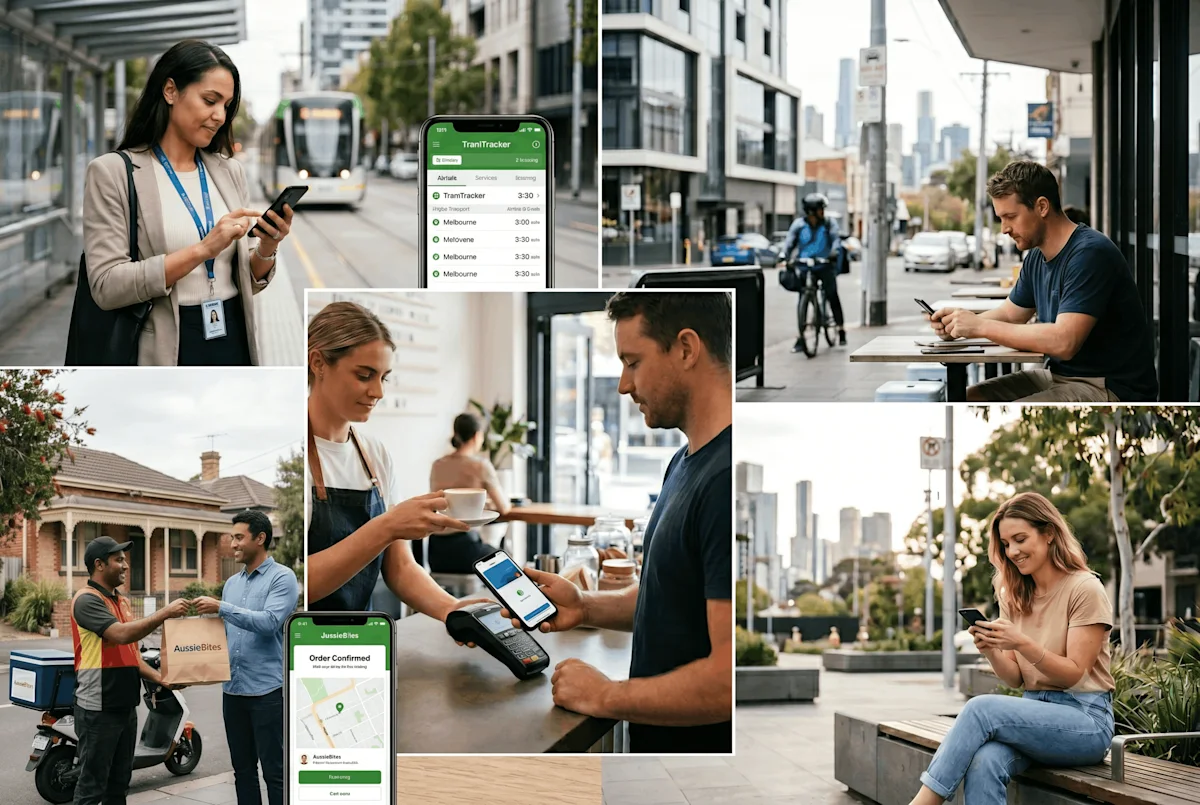
Australia is one of the most mobile-mature markets in the world. Around 22 million Australians used a smartphone in 2024, representing over 80% of the population. Australians spend an average of 2.58 hours per day on their mobile phones, according to Comparitech research published in March 2025.
The commercial opportunity is substantial. The Australian app market generated $3 billion USD in revenue in 2024, a 15.3% year-on-year increase. Australians downloaded 1.3 billion apps in 2024, up 15.9% on the previous year.
Apple holds 62.80% of the mobile OS market in Australia as of May 2026, according to Statcounter, with Android at 37.18%. Australia is one of the few markets globally where iOS commands a clear majority. For most Australian business apps, iOS compatibility is not optional.
What are the benefits of hiring an app developer in Australia?
Working with a locally based developer isn't just a matter of convenience. There are several practical and legal advantages that offshore arrangements don't reliably replicate.
- Time zone alignment: Real-time collaboration and quick iteration are significantly easier when your developer is in the same or adjacent time zone. In fast-moving projects, delays caused by time zone gaps compound quickly.
- Local market knowledge: An Australian developer who has built apps for local businesses understands the consumer behaviour, payment preferences and platform habits specific to this market. That context shapes product decisions in ways a developer working overseas may not instinctively bring to the table.
- Privacy and compliance: Apps that collect personal data from Australian users are subject to the Privacy Act 1988 (Cth) and the 13 Australian Privacy Principles (APPs). The Office of the Australian Information Commissioner (OAIC) oversees compliance with these requirements. Working with an Australian developer can make it easier to address these local compliance considerations from the start of your project.
- Accountability: A locally based developer or agency operates under Australian consumer and contract law. If something goes wrong, your legal options are considerably clearer than in a cross-border dispute.
What skills should you look for in an app developer?
The skills that matter depend on your platform, project complexity and how much you're handling in-house versus handing over entirely.

- Core technical skills: For iOS development, look for proficiency in Swift and SwiftUI, Apple's current recommended languages. For Android, Kotlin and Jetpack Compose are the modern standards. If you're building a cross-platform app, Flutter and React Native are the two most widely adopted frameworks in Australia. Back-end skills matter for apps that store data, process payments or connect to third-party services. Look for experience with APIs, cloud platforms such as AWS, Google Cloud or Microsoft Azure, and solid database management fundamentals.
- UI/UX capability: A developer who can both design and build is rare. More commonly, strong developers have either a good design instinct or experience collaborating closely with a UX designer. Ask to see how their past apps handle user flows, not just how they look in screenshots.
- Testing and version control: Quality developers test thoroughly before and after launch. Ask about their approach to QA and bug tracking, and confirm that they use version control systems such as Git. These are baseline professional practices, not optional extras worth negotiating.
- Soft skills: Communication matters as much as technical ability. You want a developer who asks the right questions before starting, challenges unclear requirements and keeps you informed throughout the project. A developer who agrees to everything in the initial conversation and then goes quiet is a red flag, not a reassurance.
What questions should you ask an app developer before hiring?
The interview stage is where most businesses move too quickly. Reviewing a portfolio is a starting point, not a finishing line. The questions you ask before signing anything reveal far more about how a developer actually works than any CV or case study will.
- Past work: Ask to see live apps they've shipped and to speak directly with the clients who commissioned them. Specifically ask what their role was on each project, as a portfolio credit doesn't confirm they built the thing. If they're reluctant to facilitate a reference conversation, that hesitation is itself informative.
- Ownership and intellectual property: Confirm clearly who owns the source code once the project is complete. The answer should be 'you do, from day one.' Ask whether the final codebase will be handed over in full and whether any third-party licensing restrictions apply.
- Process and communication: Ask how they handle scope changes mid-project and what happens to the budget and timeline when requirements shift. Find out how they prefer to communicate progress and how frequently you'll receive progress updates. A developer with a clear answer here has done this before.
- Post-launch support: Ask specifically what happens after the app goes live. Who handles bug fixes in the first 30, 60 and 90 days? Is there a maintenance agreement available, and what does it cover? An app requires ongoing attention after launch. A developer who hasn't thought about this hasn't thought about your long-term success.
- Security and compliance: If your app will collect user data, ask how they approach data security. Ask whether they're familiar with the Australian Privacy Principles under the Privacy Act 1988 (Cth). A developer building consumer-facing apps in Australia should be able to answer this without hesitation.
What is a typical mobile app development timeline?
Timeline expectations are one of the most common sources of tension between clients and developers. A client expecting a complex app in six weeks or a developer who won't commit to any estimate are both warning signs.
The phases of any app project follow a consistent structure: discovery and scoping, UI/UX design, development, testing and QA and then app store submission and launch. What changes is how long each phase takes based on the scope and number of feature complexity.
Mobile app development timeline by project type (2026)
App type | Typical timeline | What drives the duration |
|---|---|---|
Simple app (single platform, limited features) | 3 to 4 months | Minimal integrations; straightforward user flows |
Medium complexity (dual platform, user accounts, third-party integrations) | 6 to 9 months | Extended development and QA cycles; more dependencies |
Complex or enterprise app (custom back-end, AI features, high security requirements) | 12 months or more | Architecture decisions, compliance reviews, iterative testing |
App store submission alone can take one to two weeks after development is complete. Apple's review process in particular can introduce delays, so build this into your launch planning.
Post-launch fixes and iterations are also inevitable, regardless of how thorough the QA process is. Plan for at least one to two months of active monitoring after your app goes live. A timeline significantly shorter than these benchmarks for a given scope warrants a detailed explanation before you sign anything.
What are your options for hiring an app developer in Australia?
There are three main models for hiring an app developer. Each suits different project types and budgets.

- App development agency: An agency brings a full team covering development, design, project management and quality assurance. This reduces the risk of losing momentum if one person becomes unavailable and gives you a single point of accountability. Agencies suit complex builds and are more likely to provide formal contracts, structured project management and post-launch support arrangements.
- Freelance developer: A freelancer is usually a single developer working independently. They're often faster to engage, more flexible on scope changes and less expensive than agencies. For projects under $20,000, a skilled freelancer is often the most practical option. Above that threshold, an agency is worth exploring. Your project depends entirely on one person with a freelancer, which creates risk if their availability or communication deteriorates mid-project.
- In-house hire: Building an in-house team only makes sense if app development is a core and ongoing function of your business. For a one-time or occasional build, the recruitment cost, salary commitment and overhead make in-house hiring significantly more expensive than either of the above options.
How do you find and hire an app developer in Australia?
A structured process protects your budget, your timeline and your intellectual property.
Step 1: Define your project scope
Before approaching any developer, document what you want to build, who it's for and what problem it solves. List the core features needed at launch rather than the full wish list. Developers quote based on scope, and an unclear brief produces an inaccurate quote.
Step 2: Set a realistic budget
Know your ceiling before getting quotes. This determines which hiring model is appropriate. It also prevents you from wasting time on conversations with developers who are fundamentally out of your range.
Step 3: Find candidates
Bark connects you with reviewed mobile app developers across Australia. You could also use LinkedIn to find agency listings, local tech communities and meetups in your city. Personal referrals from people who have shipped a similar product are among the most reliable signals.
Step 4: Evaluate portfolios
Ask to see live apps they've built, not just mockups or design files. Download and use the apps yourself. Ask about the developer's specific role on each project, as a portfolio credit doesn't confirm they built it.
Step 5: Test with a paid brief
Give shortlisted candidates a small paid test based on a real aspect of your project. How a developer handles the brief, the questions they ask and how they communicate tells you more than a CV does.
Step 6: Check references
Speak to previous clients directly where possible. Ask specifically about communication, how problems were handled and whether they'd commission the same developer again.
Step 7: Sign a contract before work begins
A written agreement must cover project scope and milestones, payment schedule, code ownership and confidentiality obligations. Do not start work on a verbal agreement.
What are the red flags to watch for when hiring app developers?
Most costly hiring mistakes are avoidable if you know what to look for during the evaluation stage.
- Vague or incomplete quotes: A quote that doesn't break work down by phase or feature is an estimate that will almost certainly grow. Push for a detailed breakdown before agreeing to any engagement.
- No verifiable past work: If a developer can't point you to live apps they've shipped, treat the conversation with caution. A working portfolio is the minimum bar, not a bonus.
- Unclear code ownership: You should own your codebase outright from day one. Any hesitation or ambiguity on this point before a contract is signed is a serious warning sign.
- Unrealistic timelines: A developer quoting half the time of every comparable quote isn't necessarily more efficient. Ask how they arrived at the estimate and what happens to the scope if they've underestimated the complexity.
- No maintenance plan: An app isn't finished at launch. Operating system updates, security patches and feature changes require ongoing work. A developer who has no post-launch plan hasn't thought about your project the way you have.
- Poor communication from the start: If responses during the initial enquiry are slow, evasive or vague, they will be worse once you've paid a deposit and the project is underway.
Find professional mobile app developers on Bark and compare them by real client ratings
What legal and compliance requirements apply when building an app in Australia?

If your app collects personal data from Australian users, compliance isn't optional. It should be part of your developer brief from the start.
The Privacy Act 1988 (Cth) and the 13 Australian Privacy Principles apply to organisations with an annual turnover above $3 million. However, health sector businesses and government-related organisations are covered regardless of their size. Under APP 8, transferring personal data outside Australia requires either meeting Australian privacy standards or obtaining explicit user consent.
The Privacy and Other Legislation Amendment Act 2024 introduced significant changes. New criminal penalties for misuse of personal information came into force in December 2024. A statutory privacy tort allowing individuals to sue for serious invasions of privacy came into force in June 2025.
Any developer you hire should be familiar with these obligations. They should be able to advise on how your app's data architecture meets those. If your app operates in fintech, health or any sector subject to sector-specific regulation, additional requirements apply beyond the Privacy Act.
How much does it cost to hire an app developer in Australia?
Developer costs vary by experience level and hiring model. The figures below reflect current market rates for contract and project work in Australia, based on Bark's analysis of over 190 app developer quotes across the country in 2026.
App developer hourly rates by experience level (excluding GST)
Experience level | Typical hourly rate |
|---|---|
Junior developer (0 to 2 years) | $50 to $90 per hour |
Mid-level developer (3 to 5 years) | $90 to $130 per hour |
Senior developer (5+ years) | $130 to $200 per hour |
For project-based costs, complexity is the main variable. A simple app with limited features on a single platform typically starts from around $20,000. A medium-complexity app with user accounts, third-party integrations and cross-platform support commonly runs $75,000. Enterprise-grade apps regularly exceed $150,000.
These figures cover development only. Budget separately for UI/UX design, user testing, app store submission fees and ongoing maintenance. Server and API infrastructure costs also sit outside most development quotes.
The Bark mobile app development cost guide covers project costs in more detail by app type and complexity across Australia.
Hiring the right app developer in Australia involves defining your scope before you start and choosing the right model for your budget and project size. Do enough due diligence to recognise the warning signs that experienced clients have learned the hard way. The local market is active and experienced, with strong developers working across every major city and remotely nationwide.
The most expensive hire isn't the most senior developer. It's the one who starts without a contract, goes quiet mid-project or delivers a codebase you don't own.
FAQs
A simple app typically takes three to six months from kickoff to launch. A medium-complexity app with custom features and integrations often takes six to nine months. Enterprise-grade apps can take twelve months or more.


Explore all guides about growing your business
Scale your business with the right experts. Explore step-by-step guides on hiring web designers, planning work events, office cleaning, and legal services with Bark.