What muscles do push-ups work?
Last updated March 31, 2026
Push-ups are a powerful full-body exercise. Learn what muscles push-ups work, from chest and triceps to core and stabilisers, plus how form and variations change muscle activation and results.

What muscles do push-ups work?
Last updated March 31, 2026
Push-ups are a powerful full-body exercise. Learn what muscles push-ups work, from chest and triceps to core and stabilisers, plus how form and variations change muscle activation and results.


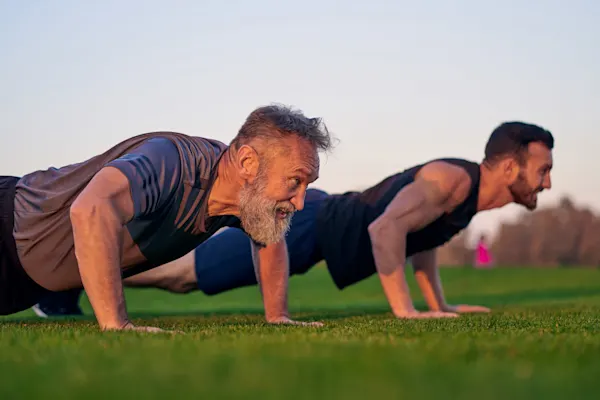
Push-ups (or press-ups) are one of the most accessible and effective bodyweight exercises. They require no equipment, can be scaled for any fitness level and target far more than just your chest. But what muscles are worked when doing push-ups, and how do press-ups compare to other upper-body movements?
This guide breaks down exactly what muscles push-ups work, how to activate them with proper form and how personal trainers use different variations to build strength, stability and muscular balance.
Push-ups are a compound movement

Push-ups are a type of compound exercise, meaning they use multiple joints and muscle groups at the same time. That’s why they’re so effective. They build strength, stability and coordination in a single movement.
The primary muscles activated include:
- Chest (pectoralis major & minor)
- Triceps (back of the upper arm)
- Front deltoids (anterior shoulders)
But push-ups go far beyond these. A well-executed push-up turns your entire upper body and core into one integrated system.
Johnny Salmon, founder of Chief Exercise Officer Pty Ltd, focuses on structured coaching that helps clients get stronger and more consistent through simple training systems. He notes that compound movements like push-ups are especially valuable because they train multiple muscle groups at once, giving you more return on the time you spend training.
If you’re unsure whether you're engaging the right muscles, a personal trainer can quickly assess your form and help you improve.
Major and supporting muscles worked by push-ups
Let’s break them down more specifically:
Chest: Pectoralis major & minor
- The pectoralis major powers the push-up by controlling the descent and driving the pressing motion.
- The pectoralis minor stabilises your shoulder blades so your arms can generate force efficiently.
Triceps brachii
- Push-ups heavily engage the triceps, especially on the ascent when the arms extend. All three heads of the triceps extend your elbows during the upward phase. Narrow or diamond push-ups increase their activation even further.
Deltoids (Shoulders)
- The anterior deltoids support the pushing motion, while the lateral and posterior deltoids help maintain shoulder stability.
Core & stabilisers

Push-ups are essentially a moving plank. That means the core works hard to maintain alignment:
- Rectus abdominis
- Transverse abdominis
- Obliques
- Deep spinal stabilisers (multifidus, erector spinae)
Back & upper body stabilising muscles
Even though push-ups push, the back plays an essential stabilising role:
- Serratus anterior - prevents “winging” of the shoulder blades
- Rhomboids and trapezius - hold scapula position
- Lats - help maintain trunk tension
These muscles work together to maintain alignment so the prime movers can generate force efficiently.
Other supporting muscles
- Forearms & wrists maintain joint alignment
- Glutes & legs keep the body rigid, preventing sagging
So, when you do push-ups well, many parts of your body are working together.
Form matters: how to ensure the right muscles get activated
To activate the right muscles and protect your joints, focus on:
- Hands directly under or slightly wider than shoulders
- Body in a straight line - ribs down, glutes tight
- Elbows angled 30–45° from your torso (not flared)
- Shoulder blades move naturally: retract on the way down, protract on the way up
- Chest lowers toward the floor with control
- Press upward by driving through the palms and engaging chest + triceps
- Maintain stable breathing (inhale down, exhale up)
Proper technique ensures that you maximise activation of the intended muscles, rather than compensating and stressing joints.
Trainer insight: A personal trainer will often cue small adjustments such as hand placement, elbow angle or core bracing that instantly improve muscle activation and reduce shoulder stress.
Jonny Cainer, a Peak Performance Coach with 25 years of elite coaching experience specialising in strength, fat loss and injury-aware training, notes that one of the most effective ways to build a stronger push-up is to begin with an incline version on a bench. He recommends focusing on full range of motion and breathing control, inhaling on the way down and exhaling as you press up to improve stability and muscle engagement.
Variations & their muscle emphasis
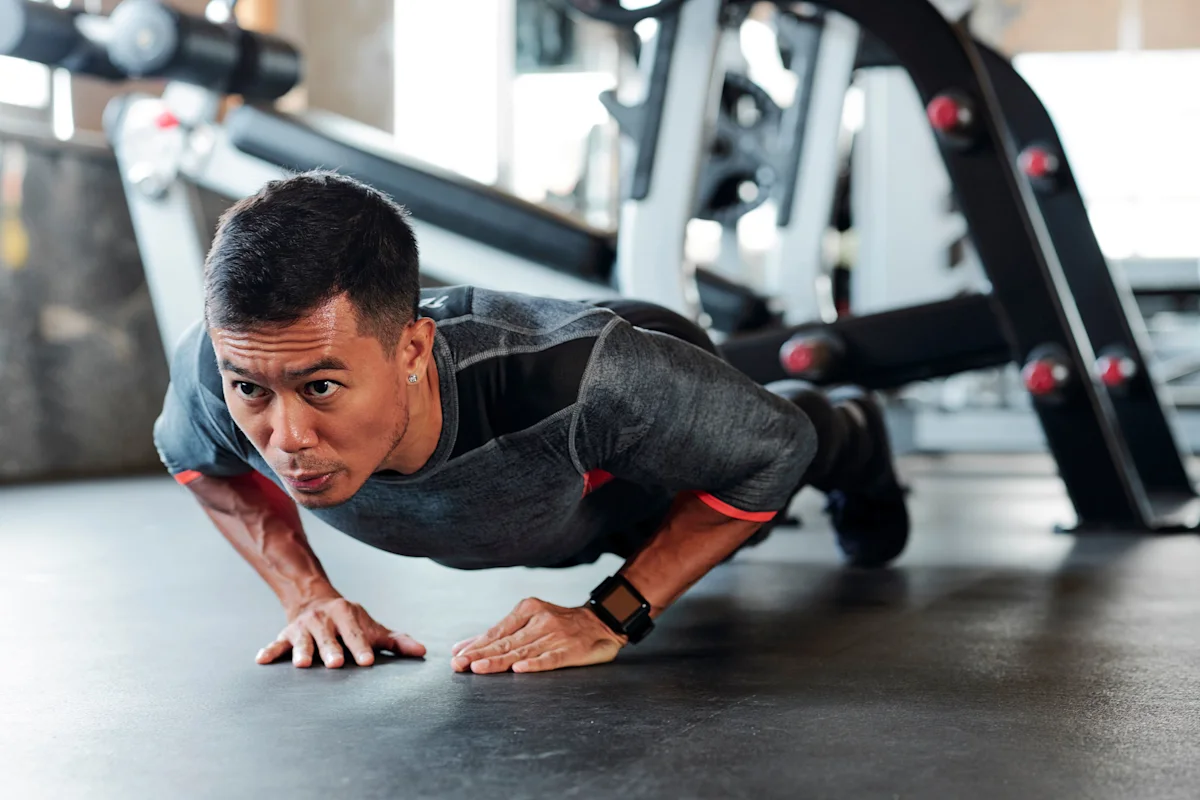
Different push-up variations can shift emphasis on certain muscle groups:
- Narrow/diamond push-ups: Great for targeting triceps and inner chest.
- Wide push-ups: Shift emphasis toward outer chest and shoulders (use with caution if you have shoulder issues).
- Incline push-ups: Easier variation; reduces load and targets the lower chest. Perfect for beginners or rehab.
- Decline push-ups: Increased difficulty; emphasises upper chest and shoulders.
- Plyometric (clap) push-ups: Build explosive power and recruit fast-twitch muscle fibres.
- Assisted push-ups (knees, bands): Help maintain proper mechanics while building strength progressively.
Selecting the right variations helps you target different muscle groups while progressing safely, especially if you’re building strength or recovering from injury.
A trainer can help you choose variations that match your strength level and goals, ensuring steady and safe progression.
Cainer also emphasises that push-up progressions work best when people build gradually with sound technique, rather than jumping straight into harder versions. Mastering controlled reps first is often what leads to the fastest long-term improvement.
Why knowing all this matters in your training
Understanding what muscles do push ups work is more than trivia. It informs how you build balanced programmes:
- Build a balanced strength routine
- Avoid overtraining your chest or shoulders
- Choose variations that target your weak points
- Fix form issues that may be limiting your progress
- Pair push-ups with pulling movements (rows, pull-ups) for better posture and muscular symmetry
These considerations help build well-rounded training habits that support long-term progress.
A personal trainer can analyse your movement patterns and tailor your push-up progressions so you build strength without aggravating joints or reinforcing bad habits.
Final word
Push-ups may look simple, but they are a powerful, full-body strength exercise. When done with proper technique, they work your chest, triceps, shoulders, core, back stabilisers and even your glutes and legs.
Knowing what muscles are worked when doing push-ups, and how variations shift the emphasis helps you train smarter, avoid plateaus and build balanced strength.
If you want expert guidance on form, injury prevention or personalised push-up progressions, you can connect with trusted personal trainers through Bark. The right trainer can help you move better, get stronger and feel more confident in every workout.
FAQs
They can do both. When you push your limits (higher reps, slow tempo, progressive overload), you stimulate muscle growth as well as endurance.


Other guides you might be interested in


Explore all guides about personal and physical growth
Find expert guides on nutrition, fitness, wellbeing, and mindset to build healthier habits. Learn when a coach, trainer, or therapist can help you grow with Bark.