
How much does a criminal defense lawyer cost?
Last updated May 5, 2026
Learn what criminal defense lawyers cost across Australia via Bark data and legal market benchmarks. This 2026 guide shows hourly rates by seniority, explains guilty plea and contested trial costs, and covers barrister brief fees and legal aid.
How much does a criminal defense lawyer cost?
Last updated May 5, 2026
Learn what criminal defense lawyers cost across Australia via Bark data and legal market benchmarks. This 2026 guide shows hourly rates by seniority, explains guilty plea and contested trial costs, and covers barrister brief fees and legal aid.
Written by

Criminal defense solicitors in Australia charge $300 to $800 per hour inc. GST in 2026, depending on their seniority and where they practise. At private practices across Australia, a Local Court guilty plea averages around $2,200 inc. GST based on current market rates. A contested District Court trial, once barrister brief fees and disbursements are included, regularly runs past $50,000 inc. GST.
Get free quotes from criminal defense lawyers near you on Bark
That hourly rate is only one input. A senior solicitor at $550 per hour who resolves your matter at a first-mention guilty plea costs less in total than a $280-per-hour generalist who allows the matter to stretch across multiple contested mentions.
A minor traffic charge resolved in the Local Court before morning tea and a Supreme Court murder trial running six weeks are both criminal defense matters. They share an hourly rate structure; almost nothing else about total cost is the same.
Here's what criminal lawyers charge at every court level and charge type across Australia. You'll also find out where to access free legal advice and duty lawyer services if private representation isn't a financial option right now.
What is criminal law in Australia?
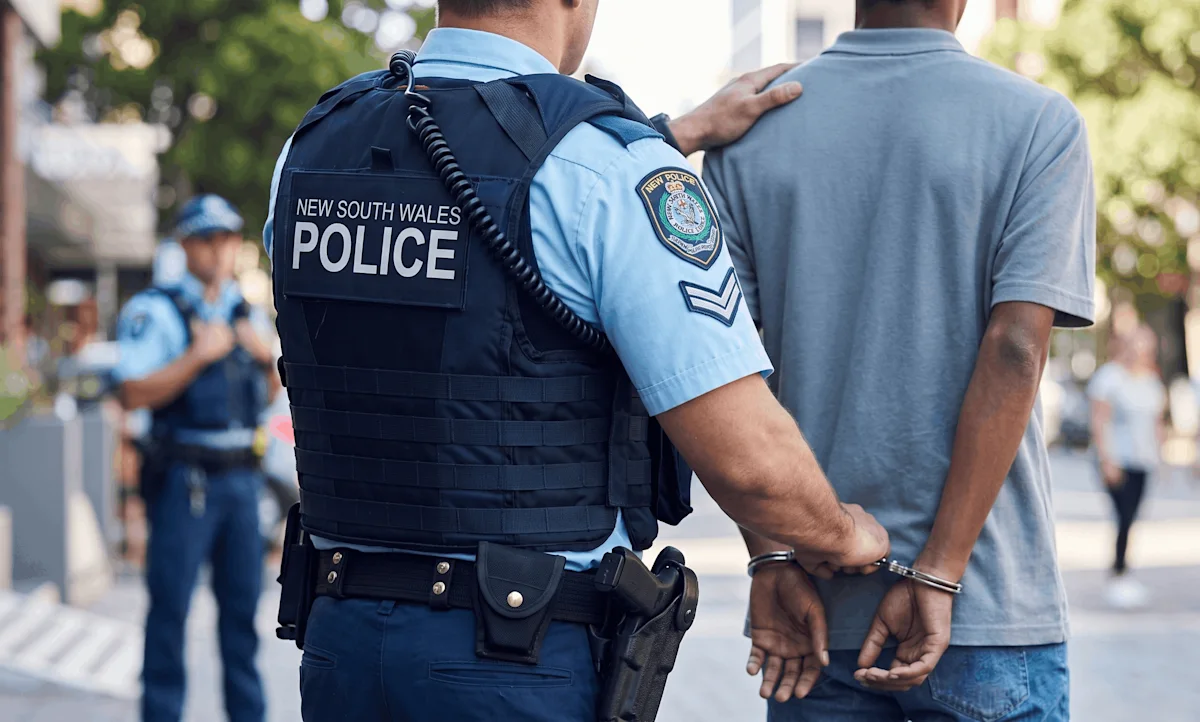
Criminal law is the body of law that defines conduct prohibited by the state and prescribes penalties for that conduct. It covers everything from minor summary offences tried in the Local Court to the most serious charges prosecuted in the Supreme Court.
In Australia, criminal law operates at two levels. Federal criminal law covers offences under Commonwealth legislation: drug trafficking across state borders, terrorism, cybercrime and fraud against the Commonwealth. State and territory law covers most charges Australians face day-to-day, including assault, theft, drug possession and drink driving.
Unlike civil law, criminal proceedings are brought by the Crown against the accused. The standard of proof is beyond reasonable doubt: the highest standard in the Australian legal system.
What are the five types of crime in Australia?
Understanding which category your charge falls into helps you assess the likely court level and cost range. The five broad categories recognised in Australian criminal law are below.
Offences against the person
These include assault, grievous bodily harm, murder, manslaughter, sexual assault and robbery. They carry the most serious maximum penalties and are most likely to proceed to a jury trial in the District or Supreme Court.
Offences against property
Theft, burglary, fraud, receiving stolen goods and property damage fall into this group. Corporate fraud and large-scale financial crime are prosecuted as property offences under Commonwealth or state legislation.
Drug offences
Possession, supply, trafficking and manufacture of prohibited substances are prosecuted under both state and Commonwealth law. Drug trafficking charges at commercial quantities carry severe maximum sentences and require experienced specialist representation.
Public order offences
Affray, riot, weapons charges, offensive conduct and obstruction fall into this category. They are dealt with in the Local or Magistrates Court and carry lower total defense costs than superior court matters.
Traffic and regulatory offences
Drink driving, drug driving and dangerous driving are criminal matters in Australia: a conviction creates a criminal record and potential licence disqualification. A driving offences lawyer or traffic lawyer can represent you at court and negotiate on charge particulars before a plea is entered.
Find a criminal defense lawyer for your charge type on Bark
What does a criminal defense lawyer actually do?

A criminal defense lawyer advises and represents a person who has been charged with, or is under investigation for, a criminal offence. The role begins well before any court date and sometimes before a charge is formally laid.
In the early stages, the solicitor reviews the police facts, explains the charge and helps the client decide whether to plead guilty or contest the matter. If the client is in custody, obtaining bail is the immediate priority.
From there, the solicitor manages the file: gathering evidence, obtaining expert reports and negotiating with the prosecution over the charge or agreed facts. They also handle all court mentions through to resolution. For serious matters in the District or Supreme Court, the solicitor briefs a barrister to act as the main advocate at trial.
What are the common criminal defenses in Australia?
A criminal defense is a legal argument that, if accepted, defeats or reduces the prosecution's case. Your solicitor assesses which defenses are available based on the police brief and any supporting evidence you can provide.
Self-defense and defense of others
Self-defense is available where the accused honestly and reasonably believed their conduct was necessary to protect themselves or another person from unlawful violence. It applies across assault, robbery and homicide charges. The test is what the accused genuinely believed at the time of the conduct.
Mental impairment
A person isn't criminally responsible for conduct resulting from a recognised mental impairment that prevented them from understanding the act or knowing it was wrong. Legislation governing this defense varies by state and territory. A successful mental impairment finding results in a supervision order rather than a conviction in most cases.
Duress
Duress operates where the accused committed an offence only because of a serious and credible threat of death or grievous bodily harm. The threat must have left no reasonable alternative. It doesn't apply to murder charges in most Australian jurisdictions.
Necessity
Necessity is available where the accused reasonably believed the offence was required to prevent a greater harm that was immediate and unavoidable. It's a narrow and rarely successful standalone defense.
Alibi
An alibi is evidence that the accused was elsewhere when the offence occurred. It's not a "defense" in the technical legal sense, but it operates to raise a reasonable doubt about the prosecution's identification case.
Consent
In offences against the person, the prosecution must prove the alleged victim didn't consent to the conduct. Consent is most frequently argued in assault and sexual assault matters, though its scope and limits vary by state legislation.
What are the different types of criminal lawyers in Australia?
The terms "criminal lawyer" covers several distinct roles with different functions, qualifications and fee structures. "Criminal solicitors" and "criminal law solicitors" are both commonly used terms for the same practitioner: a solicitor who specialises in criminal defense work.
Criminal lawyer types: Roles, functions and when each is engaged
Role | What they do | When they are engaged |
Criminal defense solicitor (criminal solicitor / criminal law solicitor) | Advises, manages the file, appears in the Local and Magistrates Court | From charge through to resolution |
Criminal defense barrister | Specialist court advocate for trials and appeals | Briefed by your solicitor for the District and Supreme Courts |
Accredited Specialist in Criminal Law | Law Society-accredited practitioner with advanced examination results | Serious or complex indictable charges |
Public Defender | Government-funded barrister (NSW, VIC and QLD) | Legal Aid-funded matters in superior courts |
Duty lawyer | Free same-day court assistance | First appearances and minor summary offences |
The Public Defender scheme operates in NSW, Victoria and Queensland. Contact your state Legal Aid commission for equivalent funding in other jurisdictions.
Most people who receive a criminal charge in Australia deal primarily with a criminal defense solicitor throughout their matter. A barrister is only engaged when the matter is committed to the District or Supreme Court.
What is the difference between a criminal lawyer and a criminal defense lawyer?
"Criminal lawyer" refers to anyone who practises in criminal law, including prosecutors who represent the Crown. "Criminal defense lawyer" specifically refers to a practitioner who represents the person charged with an offence.
If you've been charged with something, you need a criminal defense lawyer. In everyday language, the two terms are often used interchangeably, but the distinction matters when you're comparing firms.
When contacting any practice, confirm they work on the defense side of criminal proceedings. A firm that handles both prosecution and defense work may assign a less experienced solicitor to your matter.
In American legal terminology, the same role is called a "criminal defense attorney." In Australia, "attorney" isn't a recognised professional title: the correct terms are solicitor, barrister or lawyer. Searches for "criminal defense attorney near me" or "defense attorney lawyer" in Australia return qualified Australian solicitors. The role is identical regardless of which term you searched.
What is the difference between criminal law and family law?
These are separate areas of law with different court systems, standards of proof and outcomes. They overlap in practice more often than people expect, particularly when a criminal charge runs alongside an active family court matter.
Criminal law involves the state prosecuting an individual for conduct deemed harmful to society. Outcomes include a finding of guilty or not guilty, with penalties ranging from fines and community service to imprisonment.
Family law resolves private disputes between individuals: divorce, parenting arrangements and property division. It operates in the Federal Circuit and Family Court of Australia, using the lower civil standard of proof. The two systems can run simultaneously but they are managed separately.
Find a family lawyer to handle the civil side of your matter on Bark
How much does a criminal lawyer charge per hour in Australia?
Criminal defense solicitor hourly rates in Australia range from $300 to $800 per hour inc. GST. Three factors drive the rate: the solicitor's seniority and accreditation, the firm's location and the charge complexity.
Criminal lawyer hourly rates by seniority level (2026, inc. GST)
Seniority level | Hourly rate (inc. GST) |
Graduate solicitor (0-2 years PQE) | $220-$295 |
Junior solicitor (2-5 years PQE) | $295-$385 |
Mid-level solicitor (5-8 years PQE) | $385-$550 |
Senior solicitor or accredited specialist | $550-$770 |
Partner or principal, major firm | $660-$880 |
Source: Bark market data and 2026 Australian legal industry benchmarks. All rates inc. GST. PQE = post-qualified experience.
CBD firms in Sydney, Melbourne and Brisbane charge at the top of each band. Suburban and regional practices charge at the lower end, often with no material difference in outcome quality for routine criminal matters.
Graduate and junior solicitors: $220 to $385 per hour
A graduate or junior solicitor holds formal qualifications and is often supervised by a senior practitioner. At this rate level, the work suits first appearances, straightforward bail applications, simple Local Court guilty pleas and minor summary offences.
For a first-offence drink driving guilty plea on undisputed facts, a junior solicitor at $295 per hour will produce the same outcome as a senior practitioner at $660 per hour. Where the law and facts are settled, the seniority premium adds no value.
Mid-level solicitors: $385 to $550 per hour
Mid-level solicitors have 5 to 8 years of post-qualified experience across a range of criminal matters. This tier handles the most common charges competently: drug possession, assault, property offences and mid-range drink driving.
At this level, the solicitor has worked through enough similar matters to understand how local prosecutors approach charge negotiations. That pattern recognition shows most clearly in early plea discussions, where familiarity with local court culture matters more than any formal qualification alone.
Senior solicitors and accredited specialists: $550 to $880 per hour
Senior solicitors and principals at specialist firms charge at the top of the market. Accreditation as a Specialist in Criminal Law by the NSW, Victorian or Queensland Law Society requires passing additional examinations beyond standard admission requirements.
The premium reflects accumulated experience with complex indictable matters, District and Supreme Court advocacy, and relationships within the criminal bar. For any matter with a serious imprisonment risk, the per-hour premium at this level is a small component of the total matter cost. The difference in outcome is not.
How much does a criminal lawyer cost in Australia by city and state?
Location creates a consistent pricing differential across the market. CBD practitioners carry higher room hire, staffing and insurance costs than suburban or regional equivalents. These flow directly into hourly rates.
Criminal lawyer costs by city: Graduate, mid-level and senior rates (2026, inc. GST)
City | Graduate ($/hr) | Mid-level ($/hr) | Senior ($/hr) |
Sydney CBD | $260-$330 | $440-$600 | $660-$880 |
Melbourne CBD | $250-$320 | $420-$580 | $640-$880 |
Brisbane | $240-$295 | $385-$530 | $580-$770 |
Perth | $230-$295 | $360-$520 | $550-$770 |
Canberra | $240-$300 | $385-$530 | $580-$770 |
Adelaide | $220-$280 | $330-$490 | $495-$720 |
Hobart | $220-$270 | $310-$460 | $440-$660 |
Darwin | $220-$280 | $330-$500 | $495-$720 |
Regional (all states) | $180-$260 | $280-$420 | $385-$600 |
Source: Bark market data and 2026 Australian legal industry benchmarks. All rates inc. GST.
The regional discount is most pronounced for routine matters: summary offences, traffic charges and Local Court guilty pleas. For serious indictable matters in the District or Supreme Court, most practitioners appear regardless of where they're based, which reduces the geographic rate differential.
Find criminal defense solicitors in your suburb or region on Bark
How much does a criminal lawyer consultation cost in Australia?

Initial consultation fees vary significantly between practices. Many criminal defense firms offer a free 15-to-30-minute phone assessment before any formal engagement.
Firms that charge for an initial consultation bill $295 to $550 inc. GST for a 30-to-60-minute session. Some practices credit the consultation fee against the first invoice if you proceed with them.
For any matter where imprisonment is a genuine possibility, seek at least two consultations before committing to a solicitor. The quality of early strategic advice varies considerably, and the cost of a second consultation is marginal relative to the total matter cost.
How much does a guilty plea cost compared to going to trial?
The court level and whether you contest the charge are the two largest cost drivers in criminal defense. The table below shows indicative solicitor-only costs based on Bark market data.
Criminal lawyer costs by court level and matter type: Solicitor fees only (2026, inc. GST)
Matter type | Solicitor cost (inc. GST) |
Local Court: minor guilty plea (fixed fee) | $880-$1,980 |
Local Court: guilty plea (average) | $1,650-$3,300 |
Local Court: contested hearing (one day) | $3,300-$7,700 |
District Court: guilty plea | $7,700-$22,000 |
District Court: contested trial (per day) | $2,750-$5,500 |
Supreme Court: guilty plea | $22,000-$55,000+ |
Supreme Court: trial (per day) | $4,400-$8,800+ |
Source: Bark market data and 2026 Australian legal benchmarks. Figures reflect solicitor fees only and exclude barrister brief fees, daily refresher fees and disbursements.
A contested District Court trial lasting five days runs $13,750 to $27,500 in solicitor fees before any barrister costs are added. Add a mid-level barrister at $5,000 per day plus a brief fee, and the combined five-day total reaches $50,000 to $70,000 inc. GST.
Total criminal defense costs including barrister fees
Matter type | Solicitor only | With barrister | Total (inc. GST) |
Local Court guilty plea | $1,650-$3,300 | N/A | $1,650-$3,300 |
Local Court contested (1 day) | $3,300-$7,700 | N/A | $3,300-$7,700 |
District Court guilty plea | $7,700-$22,000 | $8,800-$30,000 | $16,500-$52,000 |
District Court trial (5 days) | $13,750-$27,500 | $15,000-$55,000 | $28,750-$82,500 |
Supreme Court guilty plea | $22,000-$55,000 | $30,000-$80,000 | $52,000-$135,000 |
Supreme Court trial (10+ days) | $44,000-$88,000+ | $80,000-$200,000+ | $124,000-$290,000+ |
Source: Bark market data and 2026 Australian legal benchmarks. All figures include. GST. The barrister column includes an estimated brief fee and a daily refresher for matters where barrister engagement is standard practice.
What is the difference between solicitor and barrister fees?
For most Local and Magistrates Court matters, your solicitor manages everything: advice, mentions, pleas and contested hearings. A barrister becomes relevant when your matter is committed to the District or Supreme Court for trial.
When your solicitor engages a barrister, the barrister charges a "brief fee" to review the file and prepare. A daily "refresher fee" then applies for each day of proceedings. Brief fees for criminal matters range from $3,000 for a straightforward District Court plea to $80,000 or more for a complex Supreme Court trial.
Criminal barrister brief fees and daily refresher rates by experience level (2026, inc. GST)
Barrister experience | Brief fee (inc. GST) | Daily refresher (inc. GST) |
Junior barrister (1-5 years at bar) | $3,000-$8,000 | $1,650-$3,300 |
Mid-level barrister (5-10 years) | $8,000-$20,000 | $3,300-$6,600 |
Senior barrister (10+ years) | $15,000-$40,000 | $5,500-$11,000 |
King's Counsel (KC) or Senior Counsel (SC) | $20,000-$80,000+ | $10,000-$40,000+ |
Source: Bark market data and 2026 Australian criminal bar benchmarks. All figures inc. GST.
King's Counsel and Senior Counsel are engaged only for the most serious matters: murder, terrorism, large-scale drug trafficking and complex fraud prosecutions. Their daily rates reflect narrow specialisation and high demand for their advocacy. KC brief fees for a contested murder trial regularly exceed $80,000 before refresher fees are calculated.
What are disbursements and what hidden costs should I budget for?
Disbursements are out-of-pocket costs your solicitor pays on your behalf and recovers from you. They are billed on top of professional fees and are frequently underestimated when budgeting for a criminal matter.
Common disbursements in criminal defense matters: Typical costs (2026)
Disbursement type | Typical cost (inc. GST where applicable) |
Psychiatric or forensic psychology report | $1,650-$5,500 |
Medical expert report | $1,100-$4,400 |
NAATI-accredited interpreter (per hearing) | $330-$1,650 |
Court transcript (NSW, 50 pages) | From $767 |
Private investigator for witness statements | $1,100-$5,500 |
NSW District Court filing fee | From $750 |
Process server | $110-$330 |
Source: Bark market data, NSW court fee schedules and 2026 Australian legal industry benchmarks.
Expert reports are the highest hidden cost in many criminal matters. A psychiatric report for sentencing mitigation costs $1,650 to $5,500 inc. GST. If the prosecution contests it, a second opinion and potentially an expert conclave add further expense.
Get itemised quotes from criminal defense lawyers before committing on Bark
Your solicitor must provide a costs disclosure in writing before starting work on any matter likely to exceed $750. This applies under the Legal Profession Uniform Law in NSW and Victoria, with equivalent provisions in all other states. The disclosure must include an estimate of total fees and expected disbursements.
Can I get a cheap or affordable criminal lawyer in Australia?

A low hourly rate doesn't always produce a lower total cost, and a high hourly rate doesn't guarantee a better outcome.
Fixed-fee arrangements
Many criminal defense firms offer fixed fees for defined scopes of work: guilty pleas in the Local Court, bail applications and first-mention appearances. Fixed fees remove invoice uncertainty and are the most cost-predictable structure in criminal defense.
Fixed-fee criminal defense services: Typical cost ranges (2026, inc. GST)
Fixed-fee service | Typical range (inc. GST) |
Bail application (Local Court) | $1,100-$3,300 |
First-mention appearance only | $550-$1,650 |
Local Court guilty plea (traffic offence) | $880-$1,980 |
Local Court guilty plea (summary offence) | $1,650-$3,850 |
Summary hearing (contested, one day) | $3,300-$7,700 |
Source: Bark market data, 2026. All figures inc. GST.
Suburban and regional firms
Firms outside the CBD charge 20% to 40% less per hour than city-centre equivalents, often with no material difference in quality for straightforward criminal matters. Bark lists criminal defense lawyers across metro and regional Australia so you can compare rates from solicitors in your area.
The real cost of selecting on price alone
A solicitor without direct experience in your specific charge type may produce a lower invoice and a worse outcome at sentencing. For any matter where imprisonment is a realistic possibility, don't select a solicitor on fee alone.
Get at least three quotes
Ask each solicitor about their direct experience with your specific charge type. Then ask whether a fixed fee is available for your scope of work.
Find experienced criminal defense lawyers near you who match your charge type and budget on Bark
How do I find a criminal defense lawyer near me?

Proximity is a reasonable starting point but shouldn't be your deciding criterion. A solicitor with direct experience in your specific charge type matters more than one whose office is closest to you.
Why local court knowledge matters
A solicitor who regularly appears in your local court knows how the magistrate approaches first appearances and which prosecutors are open to charge negotiation. That knowledge comes from repeated appearances in the same courthouse, not from proximity to it. For a Local Court matter, this familiarity is a genuine practical advantage.
What to ask any firm before engaging them
Ask directly: Has a solicitor from your firm personally appeared in [your court] in the last six months?
A practice that sends agents to regional courts offers a materially different service from one in which a solicitor routinely appears there. Ask also how many matters matching your charge type they have resolved in your court in the past year.
What "criminal defense law firms near me" returns in Australia
Searches for "criminal defense law firms near me" or "criminal defense near me" return a mix of large national firms and local sole practitioners. Neither is automatically better. Large firms have depth across charge types; smaller local practices often have stronger court-specific relationships and lower hourly rates.
A note on US search terms
Searches for "criminal defense attorney near me," "lawyers for criminal defense near me" or "criminal defense lawyers near me" return the same type of practitioner: a qualified Australian solicitor representing the accused. The role is identical to that of a criminal defense lawyer. Only the spelling differs.
Post your matter on Bark and receive quotes from criminal defense lawyers in your area.
Can I get legal aid for criminal charges in Australia?
Legal Aid commissions in each state and territory fund representation for people who can't afford private solicitors. Eligibility requires passing three separate tests: means, merit and appropriateness.
The means test
Your income and assets must fall below the commission's financial threshold. Thresholds vary by state and are updated regularly. Contact your state commission directly for current figures, as income limits can be lower than most applicants expect.
The merit test
Legal Aid must be satisfied that the matter has a reasonable prospect of success or raises a genuine point of law. An uncontested guilty plea on undisputed prosecution facts may not satisfy this test.
The appropriateness test
The matter must be serious enough to justify publicly funded representation. Any charge carrying a genuine risk of imprisonment ordinarily satisfies this test.
Even if you don't qualify for full-funded representation, limited assistance is still available: free phone advice, a duty lawyer at your first appearance, or funded help with a bail application.
Legal Aid commissions by state and territory
State/Territory | Commission | Website |
New South Wales | Legal Aid NSW | legalaid.nsw.gov.au |
Victoria | Victoria Legal Aid | legalaid.vic.gov.au |
Queensland | Legal Aid Queensland | legalaid.qld.gov.au |
Western Australia | Legal Aid WA | legalaid.wa.gov.au |
South Australia | Legal Services Commission SA | lsc.sa.gov.au |
Tasmania | Legal Aid Commission Tasmania | legalaid.tas.gov.au |
ACT | Legal Aid ACT | legalaidact.org.au |
Northern Territory | NT Legal Aid Commission | ntlac.com.au |
How can I get free legal advice for a criminal charge in Australia?

Several government and community services provide free criminal law advice without income requirements or means testing.
Duty lawyers
Every Local and Magistrates Court in Australia provides a duty lawyer service on court sitting days. A duty lawyer can advise you on your options and, for straightforward matters, represent you at no cost on the day. Duty lawyers are best suited to first appearances, adjournments and minor summary offences.
Community Legal Centres
More than 170 community legal centres operate across Australia, many providing free criminal law advice. Some offer ongoing representation for eligible clients. Find your nearest centre at www.clc.org.au.
State Legal Aid phone lines
Each Legal Aid commission operates a free advice line during business hours. These lines answer questions about your charge, your rights and what to expect at court. You don't need to satisfy the means test to use the phone service.
ATSILS: 1800 012 255
The Aboriginal and Torres Strait Islander Legal Service provides 24/7 urgent criminal law assistance for First Nations people across Australia. Call 1800 012 255 at any hour.
Victoria pro bono referral
Victoria Legal Aid and the Law Institute of Victoria operate a pro bono referral scheme for serious criminal matters where the accused doesn't qualify for Legal Aid. Applications are assessed case by case at legalaid.vic.gov.au.
Free criminal legal services in Australia: Eligibility, hours and best use
Free service | Eligibility | Hours | Best for |
Duty lawyer | No test (court sitting day) | Court hours | First appearance and minor matters |
Community Legal Centre | Varies by centre | Business hours | Advice and referrals |
Legal Aid phone line | None for phone advice | Business hours | Charge-specific questions |
ATSILS | First Nations people | 24/7 | Urgent criminal matters |
Victoria pro bono scheme | Serious matters, no LA eligibility | Assessed | Serious indictable charges in VIC |
What are my rights under a costs agreement?

Your solicitor must provide a costs disclosure in writing before starting work on any matter likely to exceed $750. This applies under the Legal Profession Uniform Law in NSW and Victoria, with equivalent provisions in all other states. The disclosure must include an estimate of total professional fees and expected disbursements.
You have the right to request an itemised bill at any stage of the matter. You can also apply to the relevant Law Society or Legal Services Commissioner for a costs assessment if you believe you've been overcharged. That right applies equally where the final invoice is materially inconsistent with the original estimate.
A costs agreement can't authorise overcharging. If your final bill significantly exceeds the original estimate without a corresponding change in scope, raise this formally in writing before paying any outstanding balance.
If I am found not guilty, can I get my legal costs back in Australia?
In criminal proceedings, the default position is that each party bears its own costs. An acquittal doesn't automatically entitle you to recover legal fees from the prosecution.
Exceptions exist but are narrow. In NSW, a court may make a costs order in favour of an acquitted defendant where the prosecution was clearly unjustified. The same applies where the conduct of police or prosecutors was improper or unreasonable. Western Australia has a comparable limited discretion under the Criminal Procedure Act 2004 (WA).
If you're acquitted in circumstances where a costs order may be appropriate, raise this with your solicitor before leaving the courtroom. Applications must be made at the conclusion of proceedings, and the window to raise them closes quickly.
What should I never say to a judge or magistrate in court?

How you conduct yourself in the courtroom directly affects how a judicial officer perceives you at sentencing and at any bail application.
Interrupting a ruling or arguing with the court
If you disagree with a ruling, your solicitor objects to the correct procedural process. Speaking over a magistrate or judge signals an inability to follow direction: not a quality you want demonstrated in criminal proceedings.
Volunteering information you weren't asked for
Unsolicited statements can introduce facts not otherwise before the court. Courts read this as poor judgment under pressure, which isn't a quality you want in evidence during a criminal matter.
Visible emotional reactions
Sighing, shaking your head or audible frustration are noted by judicial officers and, in jury trials, by jurors. Magistrates have broad discretion in sentencing and they weigh demeanor. Maintain composure regardless of what is being said about you.
Ultimatums or threats in the vicinity of proceedings
Any statement that could be construed as threatening witnesses, the court or the outcome is a separate criminal exposure. Say nothing you would not want read back to you in the following hearing.
What makes the best criminal defense lawyers stand out?
The best criminal defense lawyers share a small set of identifiable qualities. Most of them are assessable in a first consultation.
Charge-type specialisation
A good criminal defense lawyer doesn't practise broadly across all areas of law. Look for a solicitor whose caseload is predominantly criminal matters and who can name recent cases comparable to yours. Generalists may charge less per hour but lack the pattern recognition built from hundreds of comparable charges.
Honest about realistic outcomes from the outset
Top criminal defense lawyers give a frank assessment after reading the police facts, not before. They explain the prosecution's evidence, the realistic range of outcomes and what factors push the matter up or down that range. Confidence about results before seeing the brief is a warning sign, not a quality indicator.
Experience at the right court level
Good criminal defense lawyers have direct preparation experience at the court level where your matter will be heard. For a District Court trial, ask how many matters at that court level they have run to verdict in the past two years. For a Local Court matter, ask about specific experience with your magistrate's court.
Transparent on costs before you commit
Great criminal defense lawyers explain their fee structure clearly before you engage them and provide a written costs agreement. If a solicitor can't give you a rough total cost range after a first consultation, expect that ambiguity to persist throughout the file.
Responsive between mentions
Criminal matters move quickly: court dates list, prosecution evidence arrives and bail conditions change without warning. Your solicitor must be reachable between appearances and able to respond to urgent developments on the day they arise. Ask who manages your file day-to-day and what the response time is for non-urgent enquiries.
Compare criminal defense lawyers against these criteria on Bark
What's the bottom line on criminal defense lawyer costs in Australia?
Criminal defense solicitors in Australia on average, charge $300 to $800 per hour inc. GST in 2026. Bark data shows a Local Court guilty plea averages around $2,200 inc. GST at private practices. A contested District Court trial, including barrister fees, exceeds $50,000 inc. GST in most cases.
If cost is a concern right now, call your state Legal Aid commission's free advice line. You don't need to qualify for fully funded representation to access free advice on your charge and your options.
If your matter carries a genuine imprisonment risk, choose a solicitor with direct experience in your specific charge type. At the cost level where trials operate, the fee difference between a specialist and a generalist is marginal: the outcome difference is not.
FAQs
Drink driving is one of the most common criminal charges in Australia and is handled entirely in the Local or Magistrates Court. A guilty plea on a first-offence drink driving charge costs $880 to $2,200 inc. GST on solicitor fees at most private practices in 2026.
A contested drink driving hearing, where you dispute the blood or breath reading, runs $3,300 to $7,700 inc. GST for a one-day hearing. For high-range or repeat offences with mandatory disqualification and a risk of imprisonment, experienced representation is justified against the full cost of the conviction outcome.
Bark's research shows that most drink driving matters are resolved in one to three mentions without requiring a barrister. The main cost variable is whether you contest the reading or enter a plea at the first opportunity.


Other guides you might be interested in


Explore all guides about life's legal and financial hurdles
Your essential guide to family law, estate planning, and financial security. Learn when you need expert guidance and help with Bark.